Who we are.
Mission & History
Our Mission Statement
The mission of the Madison Symphony Orchestra, Inc. is to produce high quality concerts of orchestral, instrumental, vocal, and choral music, to educate and entertain audiences of all ages in the Madison area and beyond, and to advocate music as a universal language of expression and understanding.
About the MSO
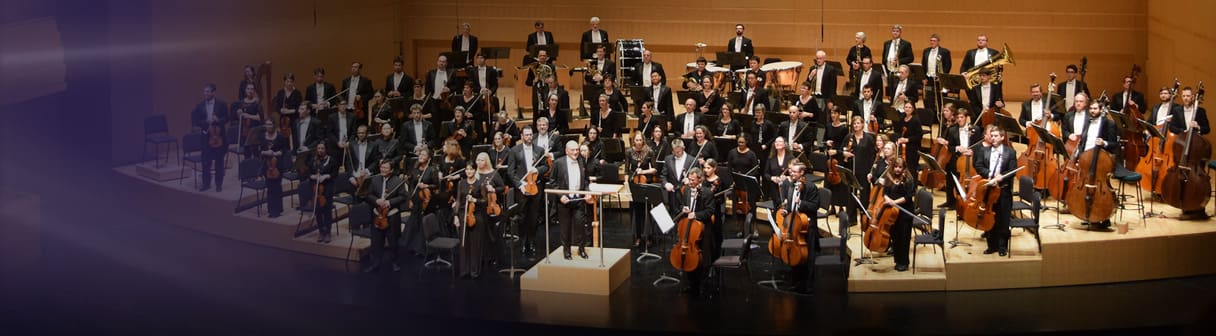
The Madison Symphony Orchestra is a phenomenon in the industry, drawing ever-growing audiences for triple performances in an acoustically excellent hall. Under the artistic leadership of Music Director John DeMain (hailed as “a gifted orchestra builder” by The New York Times), the Symphony has grown to be one of America’s leading regional orchestras. Now in its 100th season, the Madison Symphony Orchestra enriches the cultural and educational environment of Madison and the surrounding area with exquisite performances of the great masterworks and top-tier guest artists from around the world. In addition, our Education and Community Engagement Programs bring the joy of music to more than 23,000 children and adults annually. These programs are consistently recognized by national agencies including the National Endowment for the Arts and the League of American Orchestras.
The Madison Symphony Orchestra: A Timeline
Prepared by J. Michael Allsen, August 2025
Maintained by MSO Marketing
1920-25
Madison Music Committee founded in 1920. In 1925, this group reincorporated as the Madison Civic Music Association (MCMA), with a mission that included founding an orchestra in Madison. MCMA and its board will remain the umbrella organization for the Orchestra, Chorus, and (starting in the 1960s) Opera until 1994.
1926
MCMA hired Dr. Sigfrid Prager, a German immigrant, as its first Music Director, and established the Madison Civic Symphony. The orchestra, an almost entirely amateur group, began rehearsals in the fall, and gave its first concert on December 14, 1926.
1927
Founding of the Madison Civic Chorus, which gave its first concert on February 23, 1928.
1928-29
MCMA’s Civic Symphony and Chorus came under the auspices of the Madison Vocational School (later Madison Area Technical College), which hired Prager as its Music Supervisor, and paid the majority of his salary. This support was invaluable over the next eight decades, providing administrative and financial support, as well as office, library, and rehearsal spaces. The connection between the Vocational School remained in place until 2007.
1932-38
MCMA sponsored a series of successful staged opera productions.
1940
MCMA began offering all of its concerts free to the public.
1948
MCMA hired Walter Heermann as its second Music Director. Dramatic expansion in the size and responsibilities of the MCMA board. MCMA joined the American Symphony Orchestra League.
1949
Establishment of an annual youth concert as a regular part of the Madison Civic Symphony’s programming. MCMA joined ASCAP.
1950s-1964
There was a long series of incremental steps towards professionalizing the orchestra; by the 1964-65 season, all orchestra players were paid. Pay and professional standards in the orchestra continue to rise over the next six decades.
1953
After 15 seasons of concerts at the Masonic Temple Auditorium, MCMA moved its programs back to the Central High School Auditorium (later renovated as MATC Auditorium), which will remain the orchestra’s primary performance venue until 1980.
1954-68
From the beginning through the early 1960s, most of the administrative work of MCMA was carried on by volunteers, but this period saw the gradual growth of a professional, if still part-time staff.
1956
The Women’s Committee (later Madison Symphony Orchestra League) was founded as an auxiliary organization: fundraising, volunteering, organizing social events, and assisting in the orchestra’s educational programs—roles the MSOL continues to serve today.
1960
The orchestra gave its first benefit Pops concert, the “Orchestra Gala,” on April 30, 1960.
1961
MCMA hired Roland Johnson as its third Music Director. Among the changes instituted during his tenure was an expansion of the season, which grew from four regular concerts to five in his first season. By the 1970s, this had expanded to seven, with double programs (Saturday and Sunday matinee) in the 1000-seat Central High School Auditorium. In the 1980s, this expanded to eight, with single programs in the 2200-seat Oscar Mayer Theatre.
1962
Johnson and his wife Arline founded the Madison Civic Opera Workshop (later Madison Opera). This will become a third organization under the umbrella of MCMA, though it maintained a large degree of autonomy, with its own board, budget, and fundraising.
1966
The Madison Civic Symphony was formally renamed the Madison Symphony Orchestra.
1967-68
Most MCMA programs had been free to the public since 1940, but after a few years of incrementally ticketing some of its programs, all of MCMA’s regular subscription series, special and Pops concerts, and its opera productions were now ticketed in this season; only youth and neighborhood concerts remain free.
1968
MCMA hired its first full-time Business Manager (John R. Reel). The full-time administrative staff will expand to two in 1972 with a Secretary (Jean Feige). In 2024, the MSO has four full- or parttime artistic staff members, and fifteen full- or part-time administrative staff members.
1980
Opening of the Madison Civic Center. The former Capitol Theater (built in 1928) was renovated as the central performance venue, the Oscar Mayer Theatre, which will remain the MSO’s primary venue for a quarter of a century, until 2004.
1983
The Madison Civic Chorus was formally renamed the Madison Symphony Chorus.
1993
The Madison Opera successfully commissioned and premiered a new grand opera, Daron Hagen’s Shining Brow, on the life of Frank Lloyd Wright.
1994
After an international search, MCMA hired John DeMain as its fourth Music Director. There was also a thorough reorganization: MCMA was formally dissolved, and replaced by two new entities. Madison Symphony Orchestra Inc. retained the Orchestra and Chorus, and Madison Opera Inc. became an independent entity. To date, however, Madison Opera shares its Music Director with the MSO and the MSO remains the exclusive orchestra for its productions.
1994-04
Continued expansion of the MSO’s season. At the close of Johnson’s tenure, the MSO’s eight subscription concerts regularly sold most of the 2200 seats in the Oscar Mayer. DeMain announced an ambitious plan to expand to eight double concerts, with Saturday evening and Sunday matinee performances of each program. This was accomplished incrementally by the 1997-98 season. When the orchestra moved into 2255-seat Overture Hall in 2004-05, the season expanded even more dramatically: to nine triple programs, adding a Friday evening performance. Though the ninth program fell victim to the financial recession of 2008, the MSO has maintained a season of eight triple subscription programs.
2002
MSO moved its offices from the MATC Downtown facility, where it had been housed since the late 1920s to offices on Odana Road. In 2005, the offices moved again to their present location at 222 West Washington Avenue. The MSO’s office suite at this site will expand significantly in 2026.
2004
Opening of the Overture Center for the Arts. The MSO moves into Overture Hall, designed by Cesar Pelli: one of the finest orchestral venues in the country.
2005
MSO begins a three-year process of formally separating from MATC.
2009
In an NLRB-overseen vote, MSO players elect to formally associate with the American Federation of Musicians. The AFM thereafter represented the players in contract negotiations.
2020-21
MSO concerts are suspended due the COVID-19 pandemic, but through a combination of federal money and a genberous response from donors, the MSO is able to continue paying its regular musicians during the shutdown. Concerts resume, cautiously but successfully, in the 2021-22 season.
2023
John DeMain announced his resignation as the MSO’s music director, effective at the end of the 2025-26 season.
2025
MSO searches for its fifth music director and celebrates its 100th season. Longtime program annotator J. Michael Allsen publishes a book on the history of the orchestra.
2026
Laura Jackson is announced as the new Music Director Designate for the Madison Symphony Orchestra with two preview concerts in the 26-27 Season. She will take over completely as Music Director starting with the 27-28 Season.