Cirque de la Symphonie: Matching Movement to the Score
How music takes shape in motion.
By: Maja Hastings, 2025-2026 Bolz Associate
Since the dawn of time, music has been paired with movement. You could not have one without the other. Rituals, storytelling, and traditions were passed down from one generation to the next through the intersection of these two art forms. There are many examples of this convergence: the opera, musicals, folk dance, and now Cirque de la Symphonie. They fuse the two so seamlessly that it is as though the two were created for each other.
During Leonard Bernstein’s Time Square: 1944, audience members see Cirque’s “Cyr Wheel” become an extension on the music. A Cyr Wheel is a single aluminum ring made to be slightly larger than its performer. There are no handles on the Cyr Wheel, so the performer must grasp at the rim, using their body weight and momentum to create movement. Its sweeping motions surround observers with a variety of emotions, depending on the speed and direction. Much like the Cyr Wheel’s, Bernstein describes Time Square: 1944, as a “panoramic sequence in which all the sailors in New York congregate in Times Square for their night of fun.” As the wheel spins, tilts, and rolls, it mirrors the restless pulse of the city. What might otherwise be a display of balance and strength, transforms into a portrait of New York’s youthful energy, chaos of neon lights, and syncopated rhythms of jazz in Manhattan’s night air, all made visible by the steel of the Cyr Wheel and muscle of the performer.
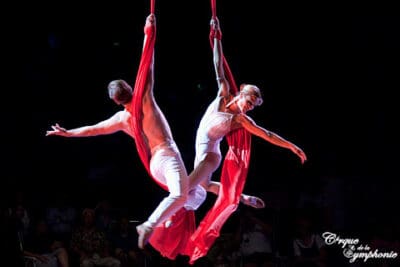 The Ribbon Dance paired with Jacques Offenbach’s The Can-Can offers another transformation of melody to rhythm. Whipping through the air, long ribbons echo Offenbach’s cheeky melodies. What was once a scandalous form of self-expression, became sheer celebration. High-kicking music is matched with high-flying dances of color and exuberance.
Each pairing asks: what does music look like? For John Williams’s Harry Potter and the Sorcerer’s Stone, the answer is a long, fluid climb, and drops of aerial silks. The silks are a specialized form of movement that involves an acrobat performing tricks, spins, and drops suspended in the air, with only a long piece of fabric holding them up. In this piece, the artists rise skyward as if lifted by magic from books, then descend in soft spirals that mirror the wonder and mystery of the wizarding world. The music’s playful and adventurous tones seem to take physical form in the folds of the silks.
As you watch our show, pay attention to how the music shapes the way you feel about each story unfolding on stage. Notice how every spin, leap, or movement is built by the score itself. The marriage of sound and sight here is more than entertainment, it’s an invitation to experience music not just with your ears, but with your whole imagination.
To read more about the history of each song and Cirque de la Symphonie’s performance visit: Sept 2025 Program Notes: Soar with Cirque de la Symphonie