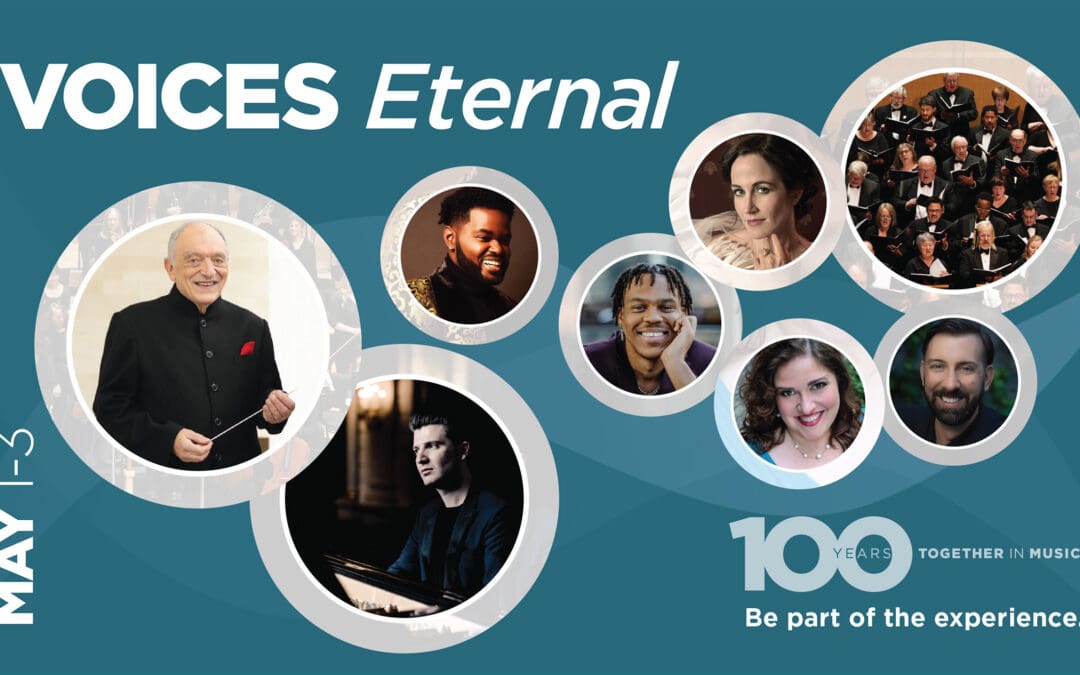
We invite you to read through Michael Allsen’s program notes for the May 1st-3rd performance of Voices Eternal.
Program Notes
To round off the subscription programs of our 100th season—the last of his distinguished 32 seasons as the Madison Symphony Orchestra’s music director—John DeMain has chosen a program of four works, most of which have resonances with the MSO’s history. (If you’re interested, check out the extended footnote at the end of the program notes.) We open with Wagner’s grand Prelude to Die Meistersinger. Italian-born pianist Alessio Bax then makes his MSO debut with Edward MacDowell’s masterwork, the Piano Concerto No. 2. The Madison Symphony Chorus then takes the stage for the second half of the program. The chorus and countertenor John Holiday will be featured in Bernstein’s Chichester Psalms, a lively setting of Hebrew Psalms composed as a profound prayer for peace. To close the program, we have Bruckner’s great Te Deum, a work featuring four fine vocal soloists: soprano Alexandra LoBianco, mezzo-soprano Adriana Zabala, tenor Travon Walker, and bass Matt Boehlor.
This stirring overture was completed some five years before the opera itself.

Richard Wagner
Born: May 22, 1813, Leipzig, Germany
Died: February 13, 1883, Venice, Italy
Prelude to Die Meistersinger von Nürnberg
- Composed: Wagner completed this instrumental prelude to his opera Die Meistersinger in early 1862, some five years before the opera was complete.
- Premiere: Wagner conducted the first performance of the Prelude at the Leipzig Gewandhaus on October 31, 1862. The opera was staged for the first time in Munich on June 21, 1868.
- Previous MSO Performance: The Madison Symphony Orchestra has performed the work on twelve previous concerts: the earliest in 1927, and the most recent in 2007.
- Duration: 9:00
Background
Die Meistersinger is part opera and part artistic manifesto.
When he was in his early 30s, Wagner made his first sketches for an opera on the life of Hans Sachs, the great 16th-century German “mastersinger.” Other projects intervened, though, and he did not turn to Die Meistersinger in earnest until he was nearly 50. The work— Wagner’s only comic opera—was completed in 1867, after more than five years of work. By that time, Wagner was world famous, both as a composer and as a center of musical controversy. Though it is billed as a comic opera (at least “comic” in a rather ponderous Wagnerian way), Die Meistersinger is at least partly an artistic manifesto. His main characters, the wise Hans Sachs, the daring Walther, and the hidebound Beckmesser are all recognizable as reflections of Wagner’s views about music. Walther’s daring new song, which breaks all of the traditional song-writing rules of the mastersingers, clearly represents Wagner’s views about his own style. Beckmesser, who attempts to thwart Walther, is a rather nasty caricature of the anti-Wagnerian music critic Eduard Hanslick.
What You’ll Hear
The piece is based upon a series of Leitmotifs.
The Prelude was finished long before the opera itself and was first performed in 1862. In his usual style, Wagner presents a series of Leitmotifs—musical themes representing characters and ideas from the drama itself. The opening music is that of the mastersingers themselves, both their processional march and a fanfare. Walther’s great love-theme follows, eventually giving way to a tongue-in-cheek version of the mastersinger music (representing a group of rather disrespectful apprentices). The climax of the piece is the simultaneous combination of several of the most important themes, culminating in a final grand statement of the mastersingers’ processional.
The first truly successful piano concerto, by an American-born composer, this remains MacDowell’s most frequently-played work.

Edward MacDowell
Born: December 18, 1860, New York City
Died: January 23, 1908, New York City.
Concerto No. 2 in D minor for Piano and Orchestra, Op. 23
- Composed: 1885
- Premiere: MacDowell was the pianist in the premiere performance in New York City on March 5, 1889.
- Previous MSO Performance:1959, with Emma Endres-Kountz, piano.
- Duration: 26:00
Background
He is hailed as an important American composer, but MacDowell’s musical style is thoroughly romantic and European.
Though Edward MacDowell is often known as the “first great American composer,” his outlook was almost entirely European. Born in New York City, he left as a teenager to study at the Paris Conservatory, and then went to the conservatory in Frankfurt, where he studied with Joachim Raff. After teaching piano in Frankfurt and Darmstadt, MacDowell returned briefly to United States in 1884, where he married Marian Nevins, who had been his piano student in Frankfurt. The MacDowells soon returned to Germany, living in Wiesbaden where he devoted the next few years entirely to composition. They returned permanently to the United States in 1888, settling in Boston. MacDowell had a successful career as a concert pianist, and able to secure occasional performances of this music. In 1896 the MacDowells moved to New York City, where he led in the creation of a music department at Columbia University, and directed the department until 1904. Shortly before his death, Marian MacDowell founded the famous MacDowell Colony in Petersborough, NY, a retreat for artists, composers, playwrights, and choreographers that still exists today. Though some of MacDowell’s later music does touch on American themes—notably Native American music—his music owes most of its style to Raff, Grieg, Schumann, and Liszt. He premiered his first piano concerto as a 22-year-old student in Frankfurt, but it is his second piano concerto that is widely believed to be his finest work. Completed while he was in Wiesbaden, it was premiered in New York City by the orchestra of Theodore Thomas in 1889. Reaction was thoroughly positive, and the fact that this was a work by an American seems to have been part of the thrill—as one reviewer wrote: “It is a splendid composition, so full of poetry, so full of vigor as to tempt the assertion that it must be placed at the head of all works of its kind produced by either a native or an adopted citizen of America.” The concerto remains the most often-performed of MacDowell’s large works.
What You’ll Hear
The concerto is in three movements:
• A broad movement in sonata form, with no fewer than than three solo cadenzas.
• A quick-footed scherzo.
• A powerful closing movement, dominated by the piano.
It is set in the traditional three movements, each of which is set in a classical sonata form. The opening movement begins with solemn introduction (Larghetto calmato) before a dramatic solo cadenza (clearly an echo of Liszt). The orchestra reintroduces the main theme and the piano amplifies it, and a more restrained second theme is transformed into a soaring melody in the solo part. A stormy development culminates in another grand cadenza. MacDowell makes room for yet a third cadenza in the recapitulation, which ends with a long wistful meditation on the opening theme. The main themes of the scherzo (Presto giocoso) were recycled from a never-completed symphonic poem on Shakespeare’s Much Ado About Nothing. Here MacDowell seems to be channeling the light-footed fairy music of Mendelssohn’s A Midsummer Night’s Dream. The movement is a brilliant virtuoso showpiece for soloist the that leads to a humorous ending. The opening of the finale (Largo) is an abrupt change in mood, with a dark, brooding melody introduced by the low strings and then carried by the soloist. Timpani strokes announce a further change in mood and tempo (Molto allegro), and the piano introduces the exuberant main idea, echoed by the brass. Piano and horn introduce a second, lighter idea. Near the end the end, there is an extended slow passage from the orchestra that echoes the introduction, but the piano soon reasserts itself to end the movement in a blazing virtuoso coda.
Bernstein’s Chichester Psalms is one of his most joyful choral works.

Leonard Bernstein
Born: August 25, 1918, Lawrence, Massachusetts
Died: October 14, 1990, New York City.
Chichester Psalms
- Composed: 1965
- Premiere: Chichester, England on July 31, 1965.
- Previous MSO Performance:1971, 1994, and 2004.
- Duration: 19:00
Background
Bernstein composed this work for the Chichester Choir Festival in early 1965, when he was on a one-year sabbatical from his post as conductor of the New York Philharmonic.
England has produced a series of fine professional ensembles that have dominated the field of choral singing in recent decades. There is an active tradition associated with cathedral choirs as well, heard most clearly at many annual choral festivals—some established in the early 18th century—where cathedral choirs join forces to perform sacred and secular music. One of the grandest of these festivals occurs every summer at Chichester Cathedral in Sussex, where the Chichester choir joins with the choirs of Winchester and Salisbury cathedrals. In 1964, the Very Reverend Walter Hussey, Dean of Chichester, gave Leonard Bernstein a commission for a large choral work to be performed at the 1965 festival. Bernstein was then in the middle of a year-long sabbatical from the podium of the New York Philharmonic, devoting his time to study and composition. Chichester Psalms was completed in May of 1965, near the end of his sabbatical—Bernstein later described the work as his “major sabbatical act.” Upon returning to his conductor’s post in October of 1965, he summed up his sabbatical experience in a pair of essays in the New York Times titled “What I Thought” and “…And What I Did.” In the second essay, set in doggerel verse, Bernstein gives some pointed criticism of the then-current musical avant garde, and a tongue-in-cheek apologia for his Chichester Psalms:
For then I had the luxury, truth to tell, Of time to think as a pure musician, And ponder the art of composition. For hours on end, I brooded and mused On materiae musicae, used and abused; On aspects of unconventiality, Over the death in our time of tonality, Over the fads of Dada and Chance, The serial strictures, the dearth of Romance, Perspectives in Music, the new terminology, Physicomathematomusicology; Pieces called Cycles and Sines and Parameters; Titles too beat for these homely tetrameters; Pieces for nattering, clucking sopranos With squadrons of vibraphones, fleets of pianos Played with the forearms, the fists, and the palms— —And then I came up with the Chichester Psalms. These psalms are a simple and modest affair, Tonal and tuneful and somewhat square, Certain to sicken a stout John Cager With its tonics and dominants in B-flat Major. But there it stands—the result of my pondering Two long months of avant-garde wandering— My youngest child, old-fashioned and sweet. And he stands on his own two tonal feet.
This “youngest child” was Bernstein’s first major composition after his Kaddish Symphony of 1963, and in many ways it seems to be a response to this earlier piece. Both are large choral compositions in Hebrew, but their characters are utterly different: the rather desolate tone of Kaddish is counterbalanced by the more serene and often joyous character of Chichester Psalms. Underlying all of Chichester Psalms is an optimistic and sincere prayer for peace: as relevant in our own time as it was in 1965. The work was originally composed for an all-male chorus, but Bernstein later reworked it for mixed chorus.
What You’ll Hear
Each of the three movements sets all or part of two different Hebrew Psalms.
• The first begins with a chorale (Psalm 108) and a lively version of Psalm 100.
• The second begins with a tranquil solo (Psalm 23), interrupted by the violent Psalm 2.
• The third opens with a peaceful version of Psalm 131, and ends with a reprise of the opening chorale, now setting Psalm 133.
The first movement opens with a powerful chorale theme, using the second verse of Psalm 108 to set the musical stage for what is to follow. The remainder of the movement sets Psalm 100 in a rollicking 7/4 meter. The second movement’s form is dictated by the distinctly different characters of the two texts Bernstein sets. Part II features an extended solo: scored originally for a boy’s voice but sung here by countertenor. The soloist begins Psalm 23 above a simple harp accompaniment—a picture of youthful King David and his lyre. This peaceful solo melody, replete with blue notes, is picked up and expanded by women’s chorus, until men’s voices rudely interrupt with Psalm 2: “Why do the nations rage?” Their violent music returns again and again to the word lamah (“why?”). The chorus returns at the end with Psalm 23, but an instrumental version of the Psalm 2 music intrudes one last time. The last movement opens with an instrumental introduction, playing a tense and unsettled version of the chorale from the opening movement. Part III begins with a much more tranquil setting of Psalm 131, flowing smoothly and quietly in 10/4 meter. At the close of the movement, Bernstein returns to the chorale melody once more, now setting the first verse of Psalm 133 for chorus alone. At the close, there is one more echo of the chorale above a hushed Amen.
The Te Deum is one of Bruckner’s final sacred works, and one that he considered to be one of his finest achievements.

Anton Bruckner
Born: September 4, 1824, Anfelden, Austria
Died: October 11, 1896, Vienna, Austria.
Te Deum
- Composed: Between 1881 and 1884.
- Premiere: anuary 10, 1886, in Vienna.
- Previous MSO Performance:1944 and 1975.
- Duration: 24:00
“When the good Lord calls me to him one day and asks, ‘where are the talents I gave you?’, I will hold out the score of my Te Deum to him, and he will be a merciful judge.” – Anton Bruckner
Background
The Te Deum was a great success at its premiere in 1886. Bruckner later considered it as a possible finale to his unfinished Symphony No. 9.
Born in a tiny Austrian village, Anton Bruckner’s first musical experiences were fairly humble. His father was the town’s schoolteacher and organist, and as a young child Bruckner was already substituting for his father in church services. As a boy, he was sent him to a neighboring village to study with the organist there, and by the time he was in his 20s he was working as an organist at the nearby monastery of St. Florian. Most of his early career was spent as a church musician there and in the somewhat larger city of Linz, where he wrote several settings of Latin sacred chants. He sought training as a composer wherever he was working, and was obviously a diligent student, mastering counterpoint and orchestration. A great turning-point came in 1865, when he attended the premiere of Wagner’s Tristan und Isolde, and met Wagner himself. His admiration for Wagner was boundless, and he seems to have attended the premiere of every subsequent Wagner opera. He took Wagner as his ideal—a fact that would cause him great trouble later in his career. In 1868, he moved to Vienna, to teach counterpoint at the conservatory, and spent the rest of his life there. Bruckner never really fit in there, however—even after his symphonies gained some success in the 1880s, he remained a kind of country bumpkin who never really gained sophistication or confidence in dealing with the Viennese musical establishment.
Bruckner had a deep and abiding Catholic faith and wrote sacred music throughout his career. His setting of the Latin hymn Te Deum laudamus (We Praise You, O God), completed in 1884, was among his final sacred pieces. The mild-mannered composer, typically humble and insecure about his works, was apparently thoroughly satisfied with the work, calling it, the “pride of my life.” Its premiere, at the concerts of the Musikverein (Music Society) in January 1886 was one of the great triumphs of Bruckner’s career. It was even praised by the staunchly anti- Wagner critic, Eduard Hanslick, who had almost never had a good word to say about Bruckner’s music.
The Te Deum is now inextricably tied to the history of his unfinished ninth symphony. He labored on this work from 1887-1894, plagued at the end by poor health, ultimately completing only the first three movements. In 1894 he retired from his position at the conservatory and announced that
I have taken on a huge task with my symphony. I shouldn’t have done it given my advanced age in poor health… Should I die before completing the symphony, my Te Deum must then be used as the fourth movement.
In fact, among the surviving sketches for the fourth movement, there is an orchestral transition that would connect the end of the third (Adagio) movement into the Te Deum. Modern performances of the ninth occasionally include the complete Te Deum at the end. (Other possibilities include simply performing it as an unfinished threemovement torso, or adding one of a few alternative completions of the fourth movement from Bruckner’s sketches by modern editors.)
What You’ll Hear
This is an emotional setting of the Te Deum and four shorter Latin chant texts.
The Te Deum is certainly among the oldest of Latin hymns, dating to at least the fourth century. It is traditionally sung to mark coronations, military victories, or other moments of great public celebration. (In Britain, for example, the Te Deum has been sung at royal coronation services for nearly 1000 years.) Bruckner set these words at the beginning of the work but then adds four additional shorter Latin texts in response. His interpretation takes full advantage of the drama inherent in the Latin text, for example in the opening movement setting “to you, Cherubim and Seraphim continually cry, proclaiming:” for soprano, mezzo, and tenor soloists, leaving the prayerful and ultimately triumphant “Holy, holy, holy…” to the chorus. The more supplicant text of Te ergo quaesumus (We beseech you, therefore) is carried largely by the solo tenor, with the other soloists coming in to punctuate the end of each phrase. In the end, the tenor is joined by a lyrical solo violin decoration, and a solemn closing pronouncement by the trombones. The third movement, Aeterna fac (Make them to be numbered with your saints in everlasting glory.), is sung entirely by the chorus in a rather surprisingly strident minor key. Much of the first half of Salvum fac populum tuum (Save Your People) is once again carried by the solo tenor, and later by the bass, with fervent interjections by the other soloists and the chorus. Then at the words, “Day by day, we bless you” (Per singulos dies) the emotional dam bursts in a powerful choral passage that eventually subsides, ending with the humble “as we have trusted in you.” The joyful final movement, In te Domine speravi (In You, O Lord, Have I Trusted) opens with an exuberant passage for soloists. Bruckner’s mastery of counterpoint is on display throughout his setting of the final line, “let me never be confounded.” This works its way through several keys before ending in a glorious passage in C Major.
A Historical Footnote
While the orchestra did not get around to a public performance of Wagner’s Prelude to Die Meistersinger until its second concert, in March 1927, this piece holds the distinction of being one of the very first works rehearsed by the fledgling Madison Civic Symphony. Writing in 1972, the orchestra’s first music director, Sigfrid Prager, recalled that this all-amateur group had a less than auspicious start at its first rehearsal in the fall of 1926. In his trademark wry style, Prager recalled that after, dismissing a huge surplus of saxophonists and trumpeters who showed up for the first rehearsal, and getting the orchestra seated, that –
At any rate, somehow the rehearsal started. We began with the relatively innocent second L’Arlesienne Suite by Bizet. The first ten minutes of it sounded as if Arnold Schoenberg had written the music when he was in a bad humor. We followed with the Meistersinger Prelude which sounded somehow more human, perhaps part of it because part of it is in C Major.
Our only previous performance of the MacDowell Piano Concerto No. 2, in October 1959, featured Madison native Emma Endres- Kountz, the youngest of six musical Endres siblings. (Their father, Mathias, was the organist at St. Raphael’s Catholic Church.) While all six of them were involved in local musical groups, Emma and two of her sisters would follow musical careers. Marie Endres served as concertmaster to the Madison Civic Symphony from 1927 to 1960. She was Madison’s preeminent violin teacher for decades and led a couple of significant amateur groups: the Madison String Sinfonia, and the Madison Bach Chorus. Older sister Olive Endres was a longtime organist at St. James’s Catholic Church (where Marie directed the choir). Olive was active as a composer through her life, and in 1958, her Magnificat won first place in the Wisconsin Composer’s Competition. Emma had the biggest career of the three: she started as a nine-year old piano prodigy, performing with the Chicago Symphony Orchestra. Like her sisters, Emma studied at the Julliard School and she later won a scholarship that allowed her to study in Paris with Nadia Boulanger, Igor Stravinsky, and pianist Robert Casadesus, who called her “one of the finest American pianists of our generation.” Emma made her home in Toledo, Ohio, and later in Chicago, and toured extensively as a soloist and recitalist in the 1940s and 1950s. She returned to Madison in 1940, 1947, and 1959 to perform with the Madison Civic Symphony.
One of our previous performances of Leonard Bernstein’s Chichester Psalms was in September 1994, at one of the orchestra’s true landmark concerts: Maestro DeMain’s inaugural program as music director of the MSO and the Madison Symphony Chorus. This was an exciting program that promised good things to come. The Chichester Psalms was the second work on a program that also featured Mozart’s brief motet Ave verum corpus, and Mahler’s Symphony No. 1—the beginning of a long-term cycle of all nine Mahler symphonies played by the MSO under DeMain. It is fitting to end his tenure in Madison with a performance of one of the works that started it.
As for the Bruckner Te Deum, there is no particular MSO-related historical significance to the work, aside from the fact that we haven’t done it in a long time: previous performances were in 1944 and 1975. However, the Latin Te Deum has been sung for centuries to celebrate particularly joyful or momentous events. It is certainly an appropriate ending to this program. As DeMain notes,
I close the program with Anton Bruckner’s epic Te Deum, a magnificent large orchestral work featuring chorus, vocal soloists, and organ. This eternal prayer of thanksgiving is the way I’ve chosen to conclude my final subscription concert and climax of the Madison Symphony Orchestra’s centennial celebration.
program notes ©2026 by J. Michael Allsen
To view current and past program notes, please visit Michael Allsen’s website.