
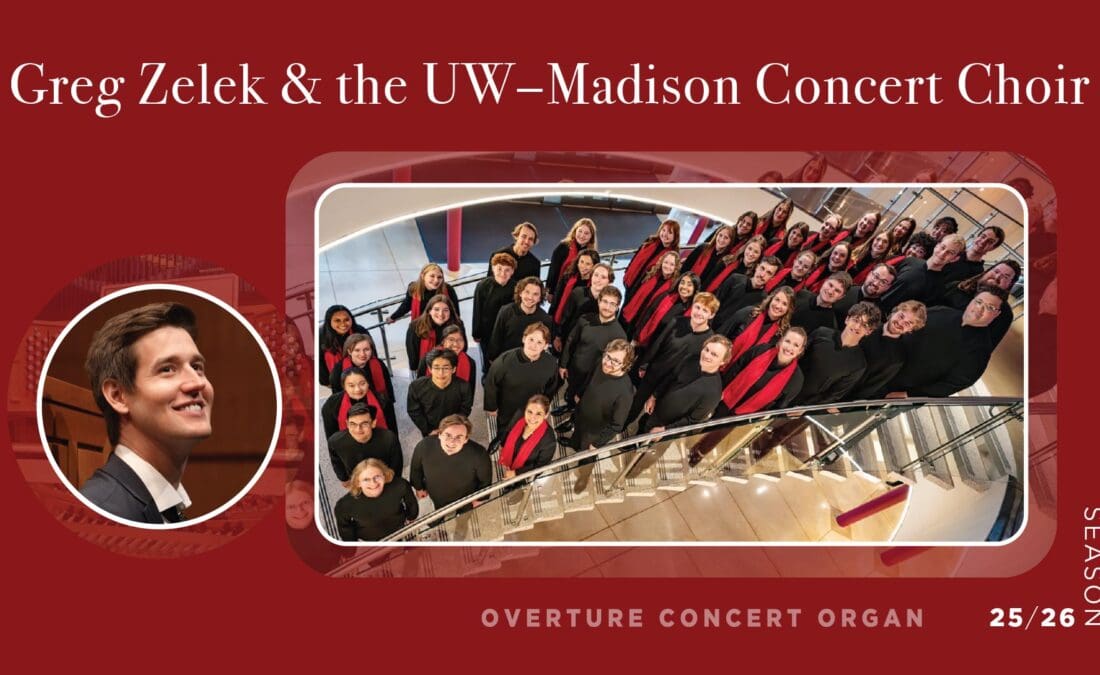
We invite you to read through Michael Allsen’s program notes for the October 2nd Organ Concert Series No. 1.
Program Notes
In our opening program, we welcome the UW–Madison Concert Choir and its director, Dr. Mariana Farah, to the stage for an evening of music for chorus and organ. We start with music in the great French organ tradition, written by Notre-Dame de Paris organist Louis Vierne, the Kyrie from his Messe Solennelle. Next is an anthem by British composer Philip Wilby, If Ye Love Me, and the bright Veni Sancte Spiritus by American Morten Lauridsen. After an inspiring setting of the familiar hymn Abide With Me, Mr. Zelek takes a solo turn with the Boëllmann Suite gothique. We are joined by eight instrumentalists—all of them music students at the University—for the festive Trinity Te Deum by Latvian composer Ēriks Ešenvalds. Samuel Barber’s Sure On This Shining Night is a gorgeous picture of a fine summer night, brightly illuminated by stars. We close with a set of three lively works from Mariana Farah’s native Brazil, the last of which, Fui no Itororó, was commissioned and premiered by the Concert Choir.
 Louis Vierne (1870-1937)
Kyrie from Messe solennelle, Op. 16
Though he was born nearly blind, Louis Vierne was able to study at the Paris Conservatory, where he became a devoted disciple of César Franck. At age 22, he became assistant organist to Charles-Marie Widor at the Parisian church of Saint-Sulpice, and in 1900 Vierne became principal organist at Notre-Dame de Paris, a position he held until his death in 1937. Vierne in fact died on the cathedral’s organ bench. On June 2, 1937, he was playing what was scheduled to be his final public recital at Notre-Dame, to an audience of 3000. He had just finished one of his own works and was getting ready to play an improvisation on a theme that had been submitted by a member of the audience, when he suddenly lost consciousness and died, victim of a heart attack or massive stroke. Vierne was a fine composer and a phenomenal improviser, but his vision problems made getting his music down on paper increasingly difficult, and he would eventually write most of his works using Braille. Despite this, his catalog includes over 60 opus numbers published during his lifetime—primarily organ and piano music, but also several choral and orchestral pieces. One ongoing concern for Vierne was the state of Notre-Dame’s enormous organ. The famed builder Aristide Cavaillé-Coll had rebuilt the cathedral’s organ in the 1860s, but it was in poor repair by the turn of the century, and Vierne worked throughout his career to support its renovation, even undertaking American tours to raise funds. [Note: After several renovations by Vierne and his successors, Notre-Dame’s organ was completely rebuilt in 1992. The organ, described by the group Friends of Notre-Dame de Paris as the “largest organ in France,” suffered only relatively minor damage during the disastrous 2019 fire. It underwent a thorough cleaning and restoration, and it was reinstalled in time for the formal reopening ceremony of Notre-Dame de Paris in December 2024.]
Vierne’s Messe solennelle (Solemn Mass) from 1900 is his only choral setting of the Latin mass. This was written for Saint-Sulpice, though by the time it premiered in December 1901, Vierne had already moved on to Notre-Dame. Its original scoring was designed to exploit the possibilities of two organs at Saint-Sulpice—a large organ in the eastern choir area, played by Vierne and an even larger one above the west entrance played by Widor. After a powerful organ passage, the chorus’s first entrance in strict imitation sets up an appropriately solemn tone. The central Christe eleison, opening with a long passage for the tenors, is lighter in character, but works its way back to the original mood during a long, intense, chromatic passage.
 Philip Wilby (1949-Present)
If Ye Love Me
Philip Wilby is a British organist, composer, organist, and choir director. He spent most of his career teaching at the University of Leeds. Though he is renowned for his sacred choral music, he is equally famous for his compositions for the British brass band. When Wilby set the Biblical text (John 14: 15-17) If Ye Love Me, he was treading ground familiar to generations of British choristers from Thomas Tallis’s anthem setting on this text, certainly among the best-known pieces of 16th-century Anglican music. However, unlike Tallis, Wilby continues the text to conclude with the Lord’s gentle words of assurance in verse 18: “I will not leave you comfortless. I will come to you.” His 1992 setting, for SSATB choir and organ, is in a calm, serene style that rises to a subdued climax on the overlapping phrases of “E’en the Spirit.”
 Morten Lauridsen (1943-Present)
Veni, Sancte Spiritus from Lux Aeterna
Morten Lauridsen, who has taught at the University of Southern California since 1967, has written in all genres, but his choral compositions are among the most often-performed vocal works by any American composer. His 1994 motet O magnum mysterium, an ethereal setting of the text of a medieval Latin Christmas chant, has become particularly popular. His closely contemporary Lux Aeterna was written in 1997 for the Los Angeles Master Chorale.
This work, originally scored for chorus and a small orchestra, brings together five Latin texts that share the metaphor of light (lux). The fourth movement, Veni Sancte Spiritus, is a 13th-century Pentecost sequence attributed to Stephen Langton, the Archbishop of Canterbury. Sequences became a semiofficial part of the mass in the late middle ages: long, rhymed poems that were chanted to complement the Proper Alleluia of the day. In the 16th century, the reforming Council of Trent purged all but five of the hundreds of sequences that had accumulated in the Latin liturgy over the preceding centuries. (The well-known Dies irae from the Mass for the Dead is one of the five survivors, as is Veni Sancte Spiritus.) In working with this joyful and lengthy text, Lauridsen sets aside his usual austerity, in favor of a straightforward setting in lilting triple meter that rises to a peak on the final line, da perenne gaudium (grant us eternal joy).
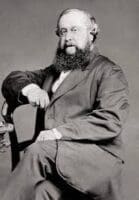 William H. Monk (1823-1889)
Abide with Me, arr. John Bertalot
The text for this popular Protestant hymn was written by the Scottish clergyman Henry Francis Lyte (1793–1847), reportedly as he lay dying from tuberculosis. The tune, usually known as Eventide, was composed in 1861 by the English choral conductor and publisher William H. Monk, for his collection Hymns Ancient and Modern. (Monk, on finding that Lyte’s expressive hymn text had no tune associated with it, reportedly wrote and harmonized Eventide in the space of about ten minutes!) The setting heard here was arranged by English organist John Bertalot (b.1953). It moves through four increasingly densely-scored verses to emerge in a triumphant fifth verse with a soaring soprano descant.
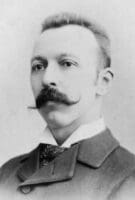 Léon Boëllmann (1862-1897)
Suite gothique, Op.25
Organist Léon Boëllmann left his native Alsace at age nine to study at Paris’s École Niedermeyer, a school dedicated to training church musicians. While there, he studied with Gustave Lefèvre and became a protégé of organist Eugène Gigout, who eventually adopted Boëllmann as his son. After Boëllmann graduated, he became assistant organist, and eventually cantor and principal organist at the Parisian church of St Vincent-de-Paul. He spent the rest of his tragically brief career there though also taught at the school of organ-playing founded by Gigout. Boëllmann died at age 35, probably of tuberculosis.
He was quite prolific in this short time, managing to publish some 150 works. The most popular of these today is his Suite gothique (1895). Boëllmann composed this work for the inauguration of a relatively small new organ in the 13th-century gothic church of Notre-Dame de Dijon: an amazingly colorful work, considering the limited palette of stops he had to work with. It opens with the Introduction – Choral, varied repetitions of a stern chorale theme. There is little that sounds identifiably “gothic” in the Menuet gothique, a sprightly and quick-footed version of this 18th-century dance. The third movement, Prière à Notre-Dame (Prayer to Our Lady) was inspired by the “Black Virgin” of Dijon, a wooden sculpture of the Virgin Mary dating to the 11th century. This is quiet, meditative music with an unhurried cantabile melody. There is a more active middle section before a return of the opening mood. The closing Toccata is a dark, turbulent work, whose repeating main theme is laid out on the pedalboard, under an intense line from the manuals.
Nevertheless, Boëllmann manages to end the work with a thundering C Major chord. [Note: I can’t help mentioning a pop culture reference: the rather creepy Toccata was used extensively as background music in the 1980s animated series The Smurfs!]
 Ēriks Ešenvalds (1977-Present)
Trinity Te Deum
Latvian composer Ēriks Ešenvalds initially studied in his native country and sang as a tenor in the acclaimed Latvian State Choir from 2002-2011. In 2011-2013, he was in England, for a fellowship at Trinity College, Cambridge. Ešenvalds is currently head of the composition department of the Latvian Academy of Music. The Te Deum laudamus (We praise Thee, O God) is certainly among the oldest of Latin hymns, dating to at least the fifth century. It is traditionally sung to mark coronations, military victories, or other moments of great public celebration. In Britain, the Te Deum has been sung in English since the 16th-century English Reformation. Ešenvalds wrote his Trinity Te Deum during his fellowship years at Cambridge, for the installation of Sir Gregory Winter as Master of Trinity College on October 10, 2012. In keeping with the festive nature of this text and the event, Ešenvalds adds trumpets, trombones, percussion, and harp to the scoring. Trinity Te Deum begins with a rousing brass fanfare, and a long opening section that comes to a peak of emotion at the words Holy, Holy, Holy: Lord God of Sabaoth. At When Thou took’st upon Thee to deliver Man, there is a distinct change, as women’s voices sing in lilting rhythm above a simple harp accompaniment. The music grows inexorably in power, until a short passage for the organ leads to a glorious reprise of the fanfare and Holy, Holy, Holy.
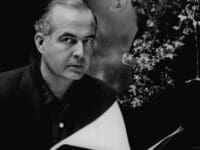 Samuel Barber (1910-1981)
Sure On This Shining Night
The late 1930s and early 1940s were heady times for a young Samuel Barber. He was successful with a series of great orchestral works that earned him international renown: his Symphony No. 1 (1936), the Adagio for Strings (1936), the Violin Concerto (1939), and his two orchestral Essays (1937 and 1942). Barber composed art songs throughout his career, and this period also saw the publication of one of his most popular collections, his Four Songs, Op. 13 (1938). The third in this collection— and possibly the most popular of Barber’s songs—is Sure On This Shining Night, setting a poem by his friend James Agee (1909-1955). Barber later set part of a lengthy prose-poem by Agee in one of his finest works, Knoxville: Summer of 1915 (1947), for soprano and orchestra. The poem Sure On This Shining Night is an optimistic picture of a glorious starlit summer night. Barber responded with music of what his biographer Barbara Heyman has called “seamless lyricism.” Barber himself arranged the choral version heard here in 1961.
 Daniel Rufino Afonso Jr. (1968-Present)
Siriri
We close with a set of three Brazilian songs, framed by a couple of folk songs arranged by renowned Brazilian-American choral director and composer Daniel Rufino Afonso. Afonso was trained in his native Rio de Janeiro and at the University of Missouri, Kansas City, and the University of Iowa. He is currently a professor of music at California State University, Stanislaus. In 2001, he founded the Modesto Symphony Chorus, a group that he still conducts today. His Siriri is an a capella arrangement of a rather silly traditional Brazilian children’s song, a cantiga de roda. As Afonso notes:
Cantigas de roda (literally, “songs of [a] circle”) are folk songs that are normally sung by young children while playing and dancing in circles. These are songs we hear even before we learn to speak, as most parents sing these simple and short tunes to their children as lullabies or as a way to play and interact with them. As a game, these songs are performed by children in a circle formation, almost always holding hands and going around together. Some songs have specific movements or “choreographies” that require that the children go in and out of the circle, make funny movements or gestures, point at each other, and choose who will get in or out of the circle next, etc.
In the case of Siriri, Siriri is a boy who seems to be ignoring the seductive invitations of the local girls. He admits that his previous attempt at a love affair led him to an ugly old woman with one leg…and he certainly doesn’t want that to happen again! It was composed for the Gay Men’s Chorus of Los Angeles in 2005, as one of several pieces that they commissioned for a planned tour of South America. According to Afonso, the humor of this song being sung by a group of gay men should be obvious. He created the SATB version heard here for one of his own choirs a few years later. Percussion dominates in this lively, cheerful setting: drums, body percussion (claps and thigh slaps), and the percussive quality of the voices themselves.
Fui no Itororó
Afonso’s Fui no Itororó (I went to Itororó) was commissioned by the UW-Madison Concert Choir and its conductor, Mariana Farah, and premiered by them in 2025 at the American Choral Directors’ Association meeting in Dallas. The composer provides the following note:
Fui no Itororó is one of the best known and most beloved Brazilian children’s songs, with its origin dating back to the 19th century. The word itororó sometimes also written as tororó comes from the Tupi language, ytororoma or “water springs.” The Tupis were one of the largest groups of native peoples in Brazil before colonization. Originally from the Amazon region, they migrated south and gradually occupied most of the Atlantic coastal region of Brazil. That is perhaps the reason why there are several places in Brazil named Itororó, which causes some confusion about the origin of the song. But the most commonly accepted story about its origin refers to the Fonte do itororó (Itororó fountain) in the city of Santos in the southeastern state of São Paulo as the place mentioned in the lyrics. They are often performed together, but there are actually three different folk songs combined here: Fui no Itororó, Ficarás souzinha (You’re going to be alone) and Tira o seu pezinho (Take your little foot off). These songs are often performed by children while playing and dancing in circles.
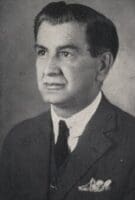 Zequinha de Abreu (1880-1935)
Tico-Tico no fubá (arr. Greg Zelek)
Tico–Tico no fubá, written by Zequinha de Abreu in 1917, is a choro, a Brazilian popular style of the 19th and early 20th centuries. Like many Brazilian forms the choro is a blend: its roots include both Western dances like the polka, mazurka and the Spanish-Cuban habanera, and West African drum rhythms. The Portuguese lyrics which were added in the 1930s, translate as The Sparrow in the Cornmeal, were a lighthearted and largely nonsensical complaint about a bird that refuses to stay away from the granary. The song was introduced to North America by organist Ethel Smith in a 1937 movie, and sheet music for her version promptly sold over two million copies. Tico-Tico again became a hit in the 1940s with recordings by the Andrews Sisters and the “Brazilian Bombshell” Carmen Miranda. It is played here in a fun arrangement by our own Greg Zelek. True to choro form, Tico-Tico no fubá has several contrasting sections, which offers some showy moments for Mr. Zelek and the Overture Concert Organ.
program notes ©2025 by J. Michael Allsen
To view current and past program notes, please visit Michael Allsen’s website.