
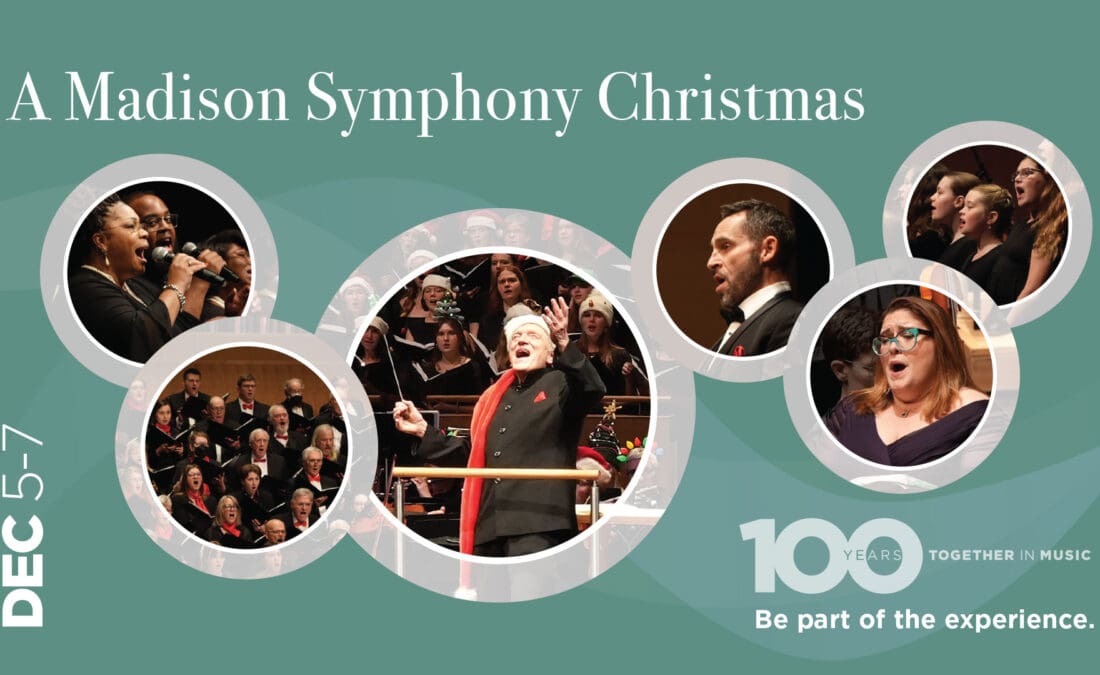
We invite you to read through Michael Allsen’s program notes for the December 5th-7th performance of A Madison Symphony Christmas.
Program Notes
Welcome to the 2025 edition of A Madison Symphony Christmas! As always, this concert is a rich and varied feast of music for the season, ranging from serious to lighthearted, and from classical works to popular holiday favorites. We welcome a pair of fine vocal soloist, both of them Madison favorites: soprano Alexandra LoBianco, and bass-baritone Kyle Ketelsen. The Madison Symphony Chorus is joined by two community choirs: groups from the Madison Youth Choirs and the Mt. Zion Gospel Choir. We also feature a soloist from the orchestra: principal hornist Emma Potter. And after a rousing Gospel finale, you get a chance to join in!
The music of English composer and choirmaster John Rutter is nearly always part of our holiday concerts, and here we begin with his setting of the Christmas hymn that has the most ancient roots of all, O Come, O Come Emmanuel. This hymn has its origins in the series of “O antiphons” (O sapientia, O radix Jesse, and several others) that were chanted as early as the 8th century at Vespers on the days leading up to Christmas—each one invoking an aspect of Jesus. In 1851, an English clergyman, John Mason Neale, adapted these ancient texts as an English poem, O Come, O Come Emmanuel and it was then set to the melody of a 15th-century plainchant hymn, Veni, Veni Emmanuel. Rutter’s arrangement is straightforward and effective, beginning with an unadorned version of the hymn in its beautiful simplicity.
In 1717 George Frideric Handel moved to England to compose and produce opera. For nearly two decades, Handel was the most successful impresario in England, but by the 1730s, Handel’s Italian opera had gone out of fashion, and he turned increasingly to the English oratorio. His oratorios—dramatic renderings of Biblical stories familiar to his English audiences—were enormously successful, and their popularity endured and grew long after Handel’s death. Messiah, composed in 1741 is, of course, Handel’s most enduring “hit,” but it is somewhat unusual among his oratorios in that his text is a pastiche of direct quotes from the King James version of the Bible. The chorus takes the lead in Messiah, and here we present the exuberant And the Glory of the Lord drawn from Part I, a series of texts from the New Testament on Christ’s birth, and Old Testament prophecies—in this case a passage from the Book of Isaiah. Then we hear Mr. Ketelsen in a dramatic recitative, Thus Saith the Lord and the aria But Who May Abide—listen for some hot, burning word-painting by Handel on the line “He is like a refiner’s fire!”
Wolfgang Amadeus Mozart’s 16-month stay in Paris in 1778-79 ended when his father commanded him to return to Salzburg, to take up the position of court organist for the archbishop. A dutiful son, Mozart returned, even though there is evidence that relations between the archbishop and the precocious composer were strained at best. Mozart chafed at the provincial nature of the Salzburg musical establishment and by late 1780 had left Salzburg forever. Despite the tradition-bound musical requirements of the Salzburg chapel, however, Mozart’s Salzburg years produced some of his finest sacred works, including the Vesperae Solennes de Confessore of 1780, is the second of his settings of the Vespers text. The most famous of the work’s movements, the soprano solo Laudate Dominum, Psalm 116, is also the most secular in style. In this movement, Mozart lifts the bassoon from its traditional role as part of the continuo to provide a quiet obbligato to the soloist. He uses the chorus to comment on the soprano’s thoroughly operatic lines.
Our next two selections feature the Madison Youth Choirs. Mack Wilberg, longtime director of the famed Mormon Tabernacle Choir, wrote his One December Bright and Clear in 2001 for treble-voice choir. This is a bright, folk-like melody that breaks joyfully into a round and then into full harmony. One unforgettable animated holiday TV special was The Snowman, which first appeared on the BBC in 1982. This British film, based upon a children’s book by Raymond Briggs, tells the story of young James, whose snowman magically comes to life on Christmas Eve, and gets into all sorts of trouble. Eventually, the snowman, who can fly (of course!), takes James on an aerial journey to the North Pole and back. For this magical moment, Howard Blake wrote the song Walking in the Air, which was memorably sung in the soundtrack by Peter Auty, who was then a choirboy at Saint Paul’s Cathedral. It is heard here in an arrangement for a choir of young voices.
Next we feature Emma Potter, currently in her third season as MSO principal horn. Mozart had a wide circle of friends in Vienna, both musical and non-musical, and by all accounts he was good company, whether at an aristocratic ball or in a tavern. One of his closest friends was a hornist named Josph Leutgeb. Leutgeb was already known as a virtuoso in Vienna in the 1750s. He spent much of the 1760s and 1770s in Salzburg, where he was closely associated with the Mozart family, and though Leutgeb was more than 20 years older than young Wolfgang, they forged a lifelong friendship. Leutgeb toured extensively as a soloist, but when he returned to Vienna in 1777, he abandoned his professional career to run a small cheese and sausage shop (purchased in part with loan from Mozart’s father Leopold). When Mozart moved to Vienna in 1781, he quickly renewed their friendship. Mozart eventually wrote four concertos for Leutgeb (There is also a fifth, fragmentary concerto, and the horn part of his Quintet for Horn and Strings, K. 407). Like many of Mozart’s friends, Leutgeb was the butt of a great deal of good-natured practical joking and insults. This extended to the music itself. In the Concerto No. 2, Mozart wrote the following dedication: “Wolfgang Amadé Mozart finally took pity on Leutgeb, [the] Ass, Ox, and Fool.” The solo line in the Concerto No. 1 included an outrageously insulting running commentary, and in the Concerto No. 4, poor Leutgeb had to decipher a 4-color code to play the solo part. There seems to have been genuine affection on both sides, however. Mozart would often stay as a houseguest with the Leutgebs when his wife Constanze was away. When Mozart died, it was Leutgeb who helped Constanze to organize the great mass of manuscripts he left behind. The Horn Concerto No. 4, completed in 1786, is perhaps the most popular in the set. The third movement (Rondo) features a rollicking main theme clearly based on valveless “hunting horn” calls.
Though he was respected in his day as composer of operas and ballet scores (including the well-known Giselle) Adolphe Adam is known to American audiences almost exclusively for his Christmas carol Cantique de Noël. Written in 1847 as a setting of a two-verse Christmas poem by Mary Cappeaux, this carol was later adapted by J. S. Wright as a three-verse English carol, O Holy Night. This performance features a newly-written arrangement by Madison’s own Scott Gendel, for our two vocal soloists and the Madison Symphony Chorus.
The distinctive musical style of Englishman John Rutter, together with his work as a conductor have made him a familiar name in the world of choral music. His Gloria, composed in 1974, was one of his first works to gain wide attention. The work was commissioned by a chorus in Omaha, Nebraska, but in relatively short order it became a favorite of choruses throughout the United States and England. The Gloria text is drawn from the Latin Mass, and it has proved a fertile source of inspiration to composers from the Middle Ages onwards. Rutter provides the following description of his Gloria: “The Latin text, drawn from the Ordinary of the Mass, is a centuries-old challenge to the composer: exalted, devotional, and jubilant by turns. My setting, which is based upon one of the Gregorian chants associated with the text, divides into three movements roughly corresponding with traditional symphonic structure.” We present the first two movements here.
As always, we return to Handel’s Messiah for the finale to our first half: the concluding Hallelujah chorus from Part II. This chorus, undoubtedly the single most famous work by Handel, has been a sensation since the first performance of Messiah in Dublin in 1742. The chorus is heard today in contexts that Handel—tireless self-promoter though he was!—never dreamed of: movies, TV ads and sitcoms, and in cover versions in styles ranging from gospel and jazz to rock, gospel, punk, and rap. The music is in no danger of becoming a mere cliché, however: it remains true to Handel’s original intent. Following the first performance of Messiah in London, the composer remarked: “My Lord, I should be sorry if I only entertained them. I wished to make them better.”
After intermission, there is a feature for the MSO. If Englebert Humperdinck’s fame today rests almost entirely upon one work, Hansel and Gretel, he was anything but a “one hit wonder” in his day. In the decades surrounding the turn of the 20th century, Humperdinck composed seven operas, incidental music for the theater, and works for both chorus and orchestra. He also held a prestigious teaching post at Frankfurt University, and was an influential music critic in several German papers. His most significant musical influence was his mentor Richard Wagner, and all of his works bear a clear Wagnerian stamp, including Hansel and Gretel. This 1892 children’s opera uses a libretto written mainly by Humperdinck’s sister Adelheide Wette. It sets the familiar story from the fairy tales of the Brothers Grimm, of a brother and sister and a menacing witch, though Wette’s version is a bit gentler than the rather disturbing—and well, grim—original. Humperdinck’s score calls for a large orchestra, but he uses his accompaniment in a very sensitive way, never allowing it to overwhelm the childlike drama on stage. While he does indeed use a few repeating musical ideas to represent characters in the drama—in the manner of Wagnerian Leitmotifs—Humperdinck’s main concern is the simple and lovely melodies sung by his characters. When Hansel and Gretel was first performed in Weimar, during the Christmas season of 1893, it was a stunning success. Richard Strauss, who directed the premiere, called it “a masterpiece of the first rank.” The Dream-Pantomime heard here comes from Act II, when Hansel and Gretel, lost in the forest and exhausted, fall asleep together on the forest floor. A group of 14 angels descend from heaven and form a protective circle around them. [NOTE: Just in case you were wondering…the 1960s British pop crooner known by the same name was born as Arnold Dorsey in 1936 and adopted the composer’s name as his stage name at the suggestion of his manager.]
Then we hear two more pieces by the Madison Youth Choirs. Canadian composer Stephen Hatfield created the version of the traditional English Apple-Tree Wassail heard here. We tend to associate wassailing with Christmas, but its origins predate the introduction of Christianity to England. According to Hatfield: “Wassail comes from the Anglo-Saxon wes hael—to be healthy. Originally, wassails were taken seriously as blessings on farms and farmers that would help ensure the health of the coming year. The Apple-Tree Wassail comes from the cider country of Devon and Somerset, where it might be sung in the orchards or at the farmer’s door. The references to ‘lily white pins’ and ‘lily white smocks’ are meant to flatter the farmer’s family by listing the fine clothing and ornaments they could supposedly afford to wear. The twelfth day of Christmas (Epiphany) was thought to be a perfect time to bless the orchards, in part because it was believed that evil spirits did their best to confound Christmas piety in the twelve days following Christ’s birth.” The hit of the 2003 holiday season was the movie Elf, starring Will Ferrell as the maniacally cheerful elf Buddy. John Debney provided a charming score, including the Main Title music heard here, in a very fun arrangement by Daniel Grassi.
One of the great TV Christmas specials” from the 1960s still watched every year is How the Grinch Stole Christmas of 1966, an animated version of the children’s book by Dr. Seuss (Theodore Geisel). Its songs were written by Geisel and successful Broadway composer Albert Hague. Featuring narration by Boris Karloff, and the unforgettable bass voice of Thurl Ravenscroft, Grinch was an instant hit. The Grinch’s theme song, heard multiple times, is the wonderfully oily You’re a Mean One, Mr. Grinch (my favorite line: “Your heart’s a dead tomato splotched with moldy purple spots.”).
I Saw Three Ships Come Sailing In is an old English carol, dating from the 17th century or earlier. The notion that ships could somehow sail into the city of Bethlehem is geographical wishful thinking, but the text is metaphorical and joyous, possibly relating to the three wise men who visited the baby Jesus. In this arrangement by James Stephenson, it is combined with the Provençal carol Bring a Torch Jeannette Isabella. This song, which may have existed by the 14th century, may actually have been a “carol” in the original sense of the word. Medieval French carols began as dance songs, and in this case it may be connected to the ancient Provençal tradition of erecting an elaborate crèche, or nativity scene, to honor the Baby Jesus.
The smash hit on Broadway in 1966 was Jerry Herman’s Mame—a musical adaptation of Patrick Dennis’s semiautobiographical novel Auntie Mame and the later play and movie version. Mame told the story of the bohemian and rather scandalous Mame Dennis, who finds herself responsible for her young nephew Patrick at the peak of the Roaring 20s. Angela Lansbury was the original Mame, in a production that ran over 1500 performances, and a 1973 movie version starred Lucille Ball in the title role. The show had several popular songs, but the biggest hit was the song Aunt Mame sings to Patrick in Act I, in which she lets us know that We Need a Little Christmas…whatever time of year it is!
As always, we end with a Gospel finale featuring the Mt. Zion Gospel Choir. The choir opens with a pair of original songs by Leotha Stanley, Joy of Christmas and The Spirit of Christmas is Love—both of them written for and premiered at previous MSO programs. Then everyone on stage joins in Stanley’s Gospel version of Joy to the World.
…and then, friends, it’s your turn to sing!
program notes ©2025 by J. Michael Allsen
To view current and past program notes, please visit Michael Allsen’s website.