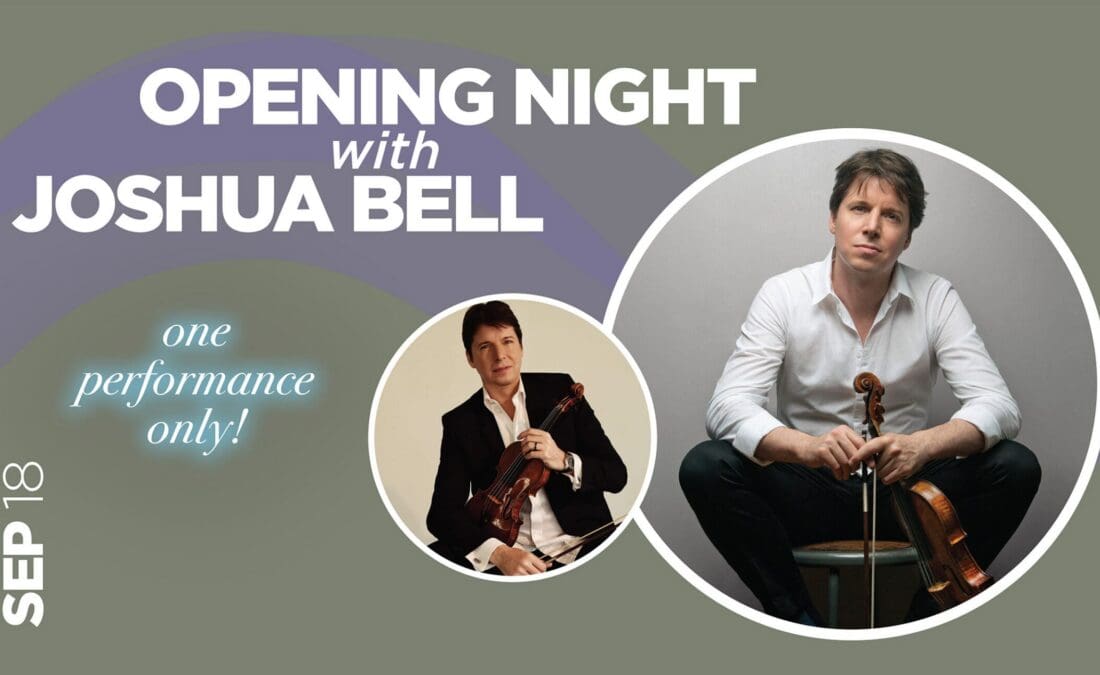
We invite you to read through Michael Allsen’s program notes for the September 18th performance of Opening Night with Joshua Bell.
Program Notes
Joshua Bell is quite simply one of the greatest violinists in the world. We present a special opening all-French concert featuring Mr. Bell in his third appearance with the orchestra. He first thrilled the MSO audience way back in September 1988 as a 21-year-old prodigy, playing Edouard Lalo’s Spanish-flavored Symphonie espagnole—the same work he plays at this program. The program opens with wonderfully evocative work, The Sorcerer’s Apprentice of Dukas, well-known to most audiences as the background to Mickey Mouse’s turn as a naughty student magician in Disney’s Fantasia. To close, the orchestra performs the hypnotic Boléro by Ravel, known for the unchanging, almost obsessive snare drum rhythm that underlies Ravel’s masterful exploration of orchestral color.
This tone poem, one of very few surviving pieces by Dukas, is also by far his most popular work.
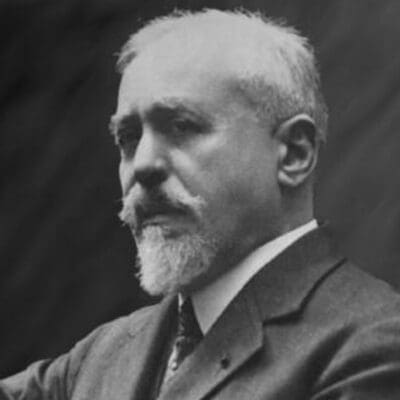
Paul Dukas
Born: October 1, 1865, Paris, France.
Died: May 17, 1935, Paris, France.
The Sorcerer’s Apprentice
- Composed: 1897.
- Premiere: May 18, 1897, in Paris
- Previous MSO Performances: Though we have played the work on numerous used programs, it has also appeared three times previously at subscription concerts, in 1966, 1988, and 1995.
- Duration: 12:00.
Background
The inspiration for this work was a ballad by Johann Wolfgang von Goethe.
Paul Dukas had a fine reputation in French music as a composer, prolific critic and writer on musical topics, music editor, and as an influential teacher of orchestration at the Paris Conservatory. As a composer, Dukas remained a staunch conservative, strongly allied to the romantic tradition—though more radical composers like Debussy and Stravinsky knew and were influenced by his work. Dukas was a careful and unsparingly self-critical musical craftsman, and published fewer than a dozen pieces in his lifetime, destroying nearly as many works that did not meet his exacting standards—often to the dismay of his friends and music publisher!
One work that did survive his ruthless self-editing was The Sorcerer’s Apprentice, subtitled “symphonic scherzo after a ballad of Goethe.” It is certainly Dukas’ most lighthearted piece, and his student Olivier Messian later insisted that it was intended as a of satire of the hyper-serious symphonic poems of Strauss and others. It was already a popular piece when Walt Disney famously adapted it as the central episode of the 1940 animated feature Fantasia. The familiar images of Mickey Mouse and single-minded animate brooms were actually drawn directly from the Goethe ballad that inspired Dukas. Goethe’s 1797 poem Die Zauberlehrling—itself based upon a Classical Greek story by Lucian—tells of a lazy student magician, who is left alone by his master with orders to fill a cistern with water. Tired of hauling buckets, he uses a spell to animate a broom to do his work. The broom does the task quickly, but the apprentice forgets the spell that will stop the broom, and the whole house is soon awash. In desperation, he whacks the broom with an axe, but to his dismay finds that that he now has not one, but two highly motivated brooms. More strikes with the axe only increases the number of brooms in exponential progression. Just when the entire house is flooded, the sorcerer returns and cancels the spell, returning everything to normal.
What You’ll Hear
This is a colorful, programmatic musical picture of the chaos caused by a magical spell gone awry.
This musical version of this story is brilliantly orchestrated and colorful, beginning with a mysterious passage that hints at the main theme. There is a sudden whirlwind of activity that represents the magic spell, and the broom, personified at first by the bassoon, comes slowly to life, playing a theme that will dominate the rest of the piece. The music becomes more and more frantic—you can feel the apprentice’s desperation as things get completely out of hand. He first tries a magic spell and then the blows of the axe are clearly heard in the music. All is quiet for a moment, but Dukas then paints the multiplying brooms coming to life with a lugubrious contrabassoon solo and a grotesque fugue. There is increasing chaotic and stormy music, until the entrance of the sorcerer, in the guise of the brass section. After a few forlorn yelps from the bassoons, representing the dying brooms, there is a quiet little epilogue, and a sudden, tongue-in-cheek ending.
This piece, certainly the most popular work by Lalo, channels the music of Spain.
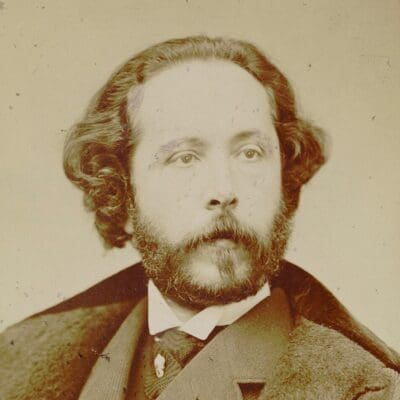
Edouard Lalo
Born: January 27, 1823, Lille, France.
Died: April 22, 1892, Paris, France.
Symphonie Espagnole for Violin and Orchestra, Op. 21
- Composed: 1874.
- Premiere: February 7, 1874, Paris, by violinist Pablo de Sarasate.
- Previous MSO Performances: 1939 (Marilyn Malone), 1953 (Henri Aubert), 1988 (Joshua Bell), and 2013 (Augustin Hadelich).
- Duration: 33:00.
Background
Something of a late bloomer as an orchestral composer, Lalo was in his 50s when wrote this work for the most important Spanish violin virtuoso of the day, Pablo de Sarasate
Though he was not particularly well-known as composer until he was in his 50s, Édouard Lalo, a Belgian, eventually became one the most important musicians in the Parisian musical scene. Unlike his good friend Berlioz, Lalo’s first interest was chamber music, and he played viola in the Armingaud Quartet, a group that was largely responsible for the revival of interest in France in the string quartets of Mozart, Haydn, and Beethoven. Despite the high quality of some of his early works, Lalo was largely ignored as a composer: chamber music was less popular in France than orchestral music and opera, and during the Franco-Prussian War in 1870-71, any composer with supposedly “German” musical sympathies was mistrusted. His prospects brightened within a few years, however. After its humiliating defeat in the war, one of the French government’s responses was to pump money into the arts, to reinvigorate French music, dance, and theatre, and to give French performing arts pride of place in Europe. Lalo benefited enormously from the support of the Société Nationale de Musique, a publicly-funded concert society. He was also befriended by the Spanish violin virtuoso Pablo de Sarasate, and Lalo wrote two large works in quick succession for his new friend: the Op. 20 violin concerto (1873) and his Symphonie Espagnole (1874). The Symphonie Espagnole became (and remains) his most popular work, and with that encouragement Lalo turned to larger forms. Over the next 14 years, he composed most of his most famous works: notably the cello concerto, his Concerto Russe (also intended originally for Sarasate), the ballet Namouna, and the opera Le roi d’Ys.
From the 1870s through the early 20th century, the French were fascinated with Spanish music—Lalo’s Symphonie Espagnole and Bizet’s Carmen a few years later were only the first of many French works that used exotic Spanish styles. But Lalo’s direct inspiration was Sarasate himself. Sarasate was well known both as a virtuoso and as a composer of Spanish-style violin music. Lalo’s use of Spanish flavor is more subtle and ultimately tastier than Sarasate’s however: Lalo used Spanish melodic figures and dance rhythms sparingly throughout the work, only occasionally letting these elements govern the music. (That is, Lalo used pinches of spice, while Sarasate and many Spanish composers who followed tended to dump in the whole jar!)
What You’ll Hear
This work is laid out in five movements:
• An opening movement set in sonata form.
• A sensuous Spanish-style dance.
• An intermezzo that features a dramatic take on the habanera.
• A folklike Andante.
• A brilliant closing rondo.
Lalo explained the unusual title in a letter: “It conveyed my thought—a violin soaring above the rigid form of an old symphony.” Each of five fairly brief movements is set in a symphonic form, beginning with the first (Allegro non troppo), which is laid out in relatively conventional sonata form—though he does make room for a concerto-style cadenza at the end of the development. Lalo works with two main ideas in this movement: a bold, martial melody and a more lyrical second idea in Spanish style. The second movement (Scherzando: Allegro molto) is a gently seductive Spanish dance with a somewhat more serious middle section. The Intermezzo (Allegretto non troppo) seems like a genteel French take on bullfighting music, with the violin spending much of the outer sections in the smoky low range above a quiet habanera rhythm, and rising to a passionate peak in the middle. The orchestra introduces the solemn folklike main idea of the Andante, which the violin then develops passionately until it introduces a brighter new idea, and launches a brief cadenza. The finale (Rondo: Allegro) is built on an animated main theme that provides the soloist with material for development. There are a few contrasting ideas, including a brief reminiscence of the Intermezzo, but the focus stays on virtuoso fireworks from the soloist throughout.
No work by Maurice Ravel is as instantly recognizable as his 1928 Boléro. This work has become a durable part of popular culture, standing for just about anything that is sensuous and seductive. It was not universally successful in its day, however!
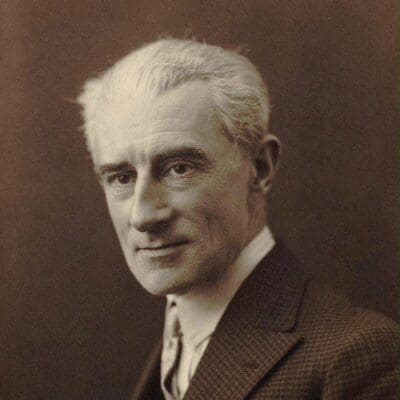
Maurice Ravel
Born: March 7, 1875, Cibourn, France.
Died: December 28, 1937, Paris, France.
Boléro
- Composed: 1928.
- Premiere: November 22, 1928, at the Paris Opéra.
- Previous MSO Performances: 1935, 1936, 1975, 1990, and 2007.
- Duration: 17:00.
Background
Boléro was written as the score for a Spanish-themed ballet by Ida Rubinstein.
Boléro is one of the later works of Ravel, and his most popular. In fact, Boléro is one of those pieces that is so popular that it risks being a cliché. It has been used in movies—perhaps most famously in a memorable scene in the otherwise forgettable 1979 film 10—television, advertising, and figure skating: usually to suggest something languorous and sexy. But the work Ravel called his “only masterpiece” remains as exciting and musically satisfying as it was in its first performance in 1928.
Boléro was written as a ballet score for dancer Ida Rubinstein. Her ballet, a solo dance set in a Spanish tavern, called for a Spanish idiom, and she originally suggested a transcription of pieces from Iberia by Isaac Albéniz. This proved to be impossible due to copyright restrictions, and instead Ravel produced an entirely new and innovative score based on a stylized boléro rhythm—a folk dance of southern Spain. The ballet production was successful, but Boléro proved to be phenomenally popular as a concert work, and it was promptly performed across Europe and America. Not everyone liked it—one American critic called it “…the most insolent monstrosity ever perpetrated in the history of music. From the beginning to the end of its 339 measures, it is simply the incredible repetition of a single rhythm….and above it is the blatant recurrence of an overwhelmingly vulgar cabaret tune…” Ravel was shocked by the strong reactions—negative and positive—to the piece, and in 1931, wrote a letter to the London Daily Telegraph explaining his intentions:
“I am particularly anxious that there should be no misunderstanding as to my Boléro. It is an experiment in a very special and limited direction, and it should not be suspected of aiming at achieving anything different from, or anything more than it actually does achieve. Before the first performance, I issued a warning to the effect that what I had written was a piece lasting seventeen minutes and consisting wholly of orchestral texture without music—of one long, very gradual crescendo. There are no contrasts, and there is practically no invention except in the plan and the manner of the execution. The themes are impersonal—folk tunes of the usual Spanish-Arabian kind. Whatever may have been said to the contrary, the orchestral treatment is simple and straightforward throughout, without the slightest attempt at virtuosity… I have done exactly what I have set out to do, and it is for listeners to take it or leave it.”
What You’ll Hear
Ravel’s Bolero was a startling piece in 1928, and it is still surprising nearly a century later. It is missing many of the things we expect in a piece of Classical music: a variety of themes, key changes, development, etc. Instead, Ravel created a stunningly original masterpiece in the use of orchestral tone color.
Ravel’s seemingly incomprehensible statement that Boléro is “without music” probably refers to its completely original form: there is none of the usual thematic development or sectional repetitions—there is simply a constantly-repeated two-part theme. There are also no changes in harmony in the traditional sense: the harmony is an unwavering C Major for the first fifteen minutes of the piece. The form is instead a constantly-evolving orchestration, changing the color and gradually adding all of the instruments of an expanded orchestra that includes such unusual timbres as piccolo trumpet, oboe d’amore, and three saxophones. Underlying all of this is the unchanging boléro rhythm played by pizzicato strings and single snare drum—in fact, one of the most challenging percussion parts in the orchestral literature! The two parts of the theme—each repeated in the form AABB—reappear some eighteen times over the course of the piece. There is a kind of inexorable growth until the very end, when without warning, the harmony abruptly changes to E Major. This seems to have been Ravel’s way of breaking the tremendous momentum of the piece—by this point it has reached critical mass, and the end is not a traditional coda, but more a kind of exhausted collapse.
program notes ©2026 by J. Michael Allsen
To view current and past program notes, please visit Michael Allsen’s website.