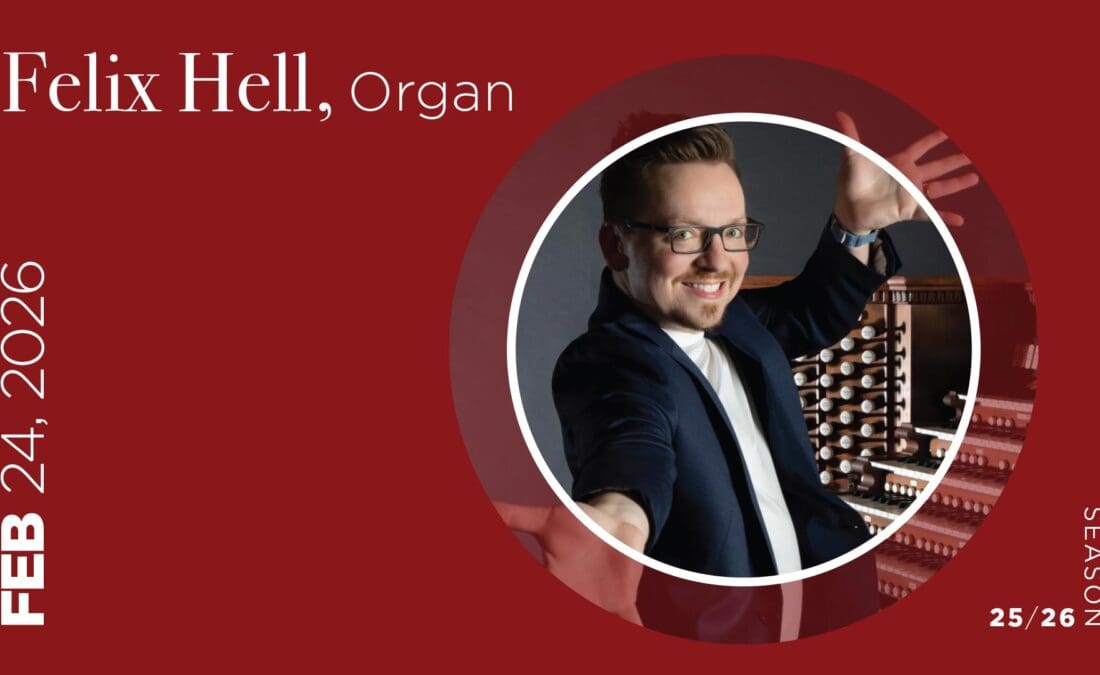
We invite you to read through Michael Allsen’s program notes for the February 24th Organ Concert Series No. 3.
Program Notes
There’s a well-known quote to the effect that: “You can’t play a symphony alone: it takes an orchestra.” If any instrument is capable of proving this wrong, it is the organ, with its flexibility and vast palette of tone colors. This program by guest organist Felix Hell include transcriptions of orchestral pieces by Bach and Barber and an unusual work by Mozart written originally for mechanical organ. And to close, Mr. Hell plays his own arrangement of one of the greatest of all symphonies, Beethoven’s triumphant fifth.
 Johann Sebastian Bach (1685-1750)
Sinfonia from Cantata No. 29, arr. Marcel Dupré
S. Bach did not invent the Lutheran church cantata—a multi-movement setting of sacred texts—but his cantatas are the finest examples of the form. As the Kantor of Leipzig’s Thomaskirche, Bach was expected to produce a cantata every week. In his first years in Leizig, Bach composed no less than five annual cycles of cantatas: each cycle including some 60 works, one appropriate to each Sunday of the Church Year, and special cantatas for Christmas, and the main feasts of Advent and Lent. Of these 300 works, nearly 200 survive. The Cantata No. 29, Wir Danken dir, Gott (“We thank you, O God”), however, was not for a Sunday service, but a civic one, a ceremony celebrating the election of the Leipzig city council on August 27, 1731. While the organ was usually in the background in Bach’s cantatas, supporting voices or playing continuo, the festive opening Sinfonia to Cantata No.29 includes a prominent virtuoso part for the instrument—virtually a short solo concerto for organ. Bach was effective at reusing his own music, and adapted this part from one of his partitas for solo violin. The result was a virtuoso showpiece intended either for Bach himself or for his talented son Wilhelm Friedemann. It is heard here in an adaptation by the great French organist and composer, Marcel Dupré (1886-1971).
 Wolfgang Amadeus Mozart (1756-1791)
Fantasia in F minor, K. 608
In October 1790, Mozart accepted one of the more unusual commissions of his career—to write music for a mechanical organ. There was a vogue at the time for “automata” of all sorts, and mechanical organs, which featured pieces laboriously programmed and played automatically were particularly popular. Composers as prominent as Handel, C.P.E. Bach and Haydn had already written pieces for mechanical organ, and Beethoven would try his hand at the medium a few years later. In this case, the instrument was owned by one “Herr Müller” (in reality, Count Deym von Stržitéž, who had adopted the name Müller after he had been forced to flee Vienna after a duel). Müller was planning to open a mausoleum in honor of the late Field Marshal Baron von Loudon, and the centerpiece of this was to be an hourly performance of “Funeral Musique” by “Herr Kapellmeister Mozart.” For his part, Mozart does not seem to have been particularly enthusiastic about the commission, complaining to his wife that: “If it were for a large clock and would sound like an organ, then I might get some fun out of it. But, as it is, the works [of Müller’s instrument] consist solely of shrill little pipes, which sound too high-pitched and too childish for my taste.” However, he eventually completed three works for the mechanical organ, the most successful of which, the Fantasia in F minor, was completed on March 3, 1791. The Fantasia was quickly published in various versions following Mozart’s death, and became particularly popular as a keyboard piece. Set in a broad rondo form it begins with a solemn funereal passage that returns at several points to link the piece together. The contrasting episodes include a pair of stern fugues at the beginning and end and long, lyrical central passage that sounds like a lovely aria from a Mozart opera.
 Samuel Barber (1910-1981)
Adagio for Strings, Op. 11, arr. William Strickland
In 1937, when the venerable conductor Arturo Toscanini was organizing the group that was to become the NBC Symphony Orchestra, he expressed an interest in programming new music by American composers. His colleague Artur Rodzinsky suggested the young Samuel Barber. Toscanini contacted Barber and Barber promptly sent two new works: his First Essay for Orchestra, and an arrangement for string orchestra of the Adagio movement of his String Quartet No.1. Barber waited through the orchestra’s first season for a reply and when the scores were finally returned without comment, he began dejectedly to look for a new orchestra to play them. In the summer of 1938, Barber was in Italy with his partner Gian-Carlo Menotti. Menotti suggested a visit to the Toscaninis at their summer villa, but Barber refused to go. When Toscanini asked why Barber had not come, Menotti offered a weak excuse about Barber being ill. Toscanini replied: “Oh, he’s perfectly well; he’s just angry with me, but he has no reason to be. I’m going to do both of his pieces.” (It seems that Toscanini had already memorized the scores—he did not ask for them again until the day before the concert!) Both works were successful at their November 1938 premiere, and Toscanini recorded both soon afterwards with the NBC Orchestra.
The Adagio for Strings has come to have an association with tragedy—particularly with great public events of death and mourning—that Barber never really intended. It was played directly after the radio announcement of President Roosevelt’s death in 1945, and similarly after the Kennedy assassination in 1963. In my case, I well remember performing in a Madison Symphony Orchestra concert a few weeks after the 9/11 attacks, when the Adagio was played as an unannounced prelude in tribute to the victims—to devastating emotional effect, Because of these associations, it has also been used in film and television to underscore tragic moments—most notably in Platoon and The Elephant Man, but also in many other scores. Shortly after Barber’s death, composer Ned Rorem said of the Adagio: “If Barber, twenty-five years old when it was completed, later reached higher, he never reached deeper into the heart.”
It is the stark simplicity of this music that makes it so effective. A simple diatonic melody builds gradually from its quiet beginning through thickening texture, canonic imitation, and increasing dissonance to an intense emotional climax as the melody reaches its highest register. After this peak, there is a brief return to the opening texture and a quiet conclusion that dies away to nothingness. The version heard here is by the American organist and conductor William Strickland (1919-1881). After a series of prestigious organ posts, culminating on the bench of Calvary Church in New York City, Strickland spend much of his career as a conductor, beginning as the first music director of the Nashville Symphony Orchestra in 1946. A great champion of American music, he was responsible for editing a number of works for organ by American composers like Barber.
 Ludwig van Beethoven (1770-1827)
Symphony No. 5 in C minor, Op. 67, arr. Felix Hell
“It is merely astonishing and grandiose.”
– Johann Wolfgang von Goethe
Although preliminary sketches of Beethoven’s Symphony No.5 date from as early as 1804, the bulk of the work was written in 1807-08, at roughly the same time as the Symphony No. 6. Both symphonies were performed for the first time at a benefit concert in Vienna on December 22, 1808. The program for this landmark (marathon!) event also included excerpts from his Mass in C and the concert aria Ah, perfido, together with premieres of two works with Beethoven himself at the piano, the Piano Concerto No. 4 and the hastily-composed Choral Fantasy. After a bit of initial resistance from audiences and fellow musicians—this was, after all, a truly avant garde work—the Symphony No. 5 was recognized as a masterpiece, and has remained the single most familiar of Beethoven’s works since then.
This was a remarkable work for its time…or any time. Though not as long as his groundbreaking “Eroica” symphony of 1803, this work is played by an expanded orchestra that includes instruments seldom heard in earlier symphonies: piccolo, contrabassoon, and trombones. Beethoven was obviously proud of this innovation, and wrote to Count Franz von Oppersdorf that “…this combination of instruments will make more noise, and what is more, a more pleasing noise than six kettledrums!” Also new is the degree to which all of the four movements are linked thematically. The famous four-note motive of the opening movement reappears in all three successive movements, and nearly all of the main musical ideas are linked in some way.
There is no more recognizable motive in Western music than the opening four notes of the first movement. Whether or not Beethoven attached a specific meaning to this motto is unclear. His first biographer, Anton Schindler reported that Beethoven referred to this motive as “Fate knocking at the door,” but this may be apocryphal. Later times have attached all sorts of meanings it. For example, during World War II, because of its identity with the Morse Code “V,” it became the musical emblem of Allied victory. At the same time, it was viewed by the Nazis as one of the most purely “German” nationalistic works. In purely musical terms, however, Beethoven’s use of this rhythm in the opening movement is a work of genius. With two statements of this four-note motto, Beethoven brusquely tosses aside the stately Classical tradition of long, slow introductions, and jumps directly into the body of the movement (Allegro con brio). The opening theme is almost entirely spun out from the motto, and even the second theme, stated sweetly, is brazenly announced by the motto from the brass. The motto is also the focus of the development section. The headlong rush of the recapitulation is abruptly broken by a brief solo cadenza (played in the original by oboe), seemingly at odds with the nature of this movement, but actually a logical continuation of the main theme. Beethoven reserves his most savage fury for the coda, the longest single section of this movement, and another section of intense development.
The second movement (Andante con moto) is a very freely-constructed theme and variations. The theme is laid out first by strings and then more robustly. In the first variation, this is ornamented by delicate tracery. In the second, the theme is sparsely outlined, and in the third theme is almost completely obscured by rushing lines. At this point Beethoven launches into a section of very free development, beginning with a lovely pastoral passage.
The Scherzo (Allegro) begins mysteriously in the low register, but soon picks up as much power as the opening movement, with a statement of the motto by the brass. The central trio moves from minor to major, and has a blustering theme in the lower strings developed in fugal style. When the main idea returns, it is strangely muted, and it quickly becomes apparent that this movement is not going to end in any conventional way. In place of a coda, there is a long and mysterious interlude, building gradually towards the most glorious moment in this work: the triumphant C Major chords that begin the Finale.
The fourth movement (Allegro) is where Beethoven suddenly augments the orchestra with trombones and contrabassoon. This orchestral effect, probably inspired by contemporary opera, is stunning, and is replicated in Mr. Hell’s organ arrangement. The opening group of themes is noble and forceful and the second group, is more lyrical, but no less powerful. New material is introduced in the closing bars of the exposition. The development focuses on the second group of themes, expanding this material enormously. Just as the development section seems to be finished, there is a reminiscence of the Scherzo—bewildering at first, but then perfectly logical as it repeats the movement’s transitional passage and leads to the return of the main theme. While the recapitulation is rather conventionally laid out, the vast coda continues to break new ground. As in the development section, things seem to be winding to close when Beethoven takes an unexpected turn: in this case a quickening of tempo to bring the symphony to a conclusion in a mood of grand jubilation.
program notes ©2026 by J. Michael Allsen
To view current and past program notes, please visit Michael Allsen’s website.