
We invite you to read through Michael Allsen’s program notes for the March 31st Organ Concert Series No. 4.
Program Notes
For this closing program of the organ series, Grek Zelek has invited nine colleagues and friends from the Madison Symphony, Orchestra to perform a varied program: violinists Leanne Kelso an Hillary Hempel, violist Christopher Dozoryst, cellist Karl Lavine, bassist David Scholl, oboist Izumi Amemiya, bassoonist Cynthia Cameron Fix, and hornist Emma Potter.
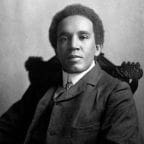 Samuel Coleridge-Taylor (1875-1912)
Finale from Nonet in F Minor, Op. 2
We open with a piece by Afro-British composer Samuel Coleridge-Taylor. He was born in 1875—the son of an African father, a prominent doctor from Sierra Leone, and an English mother—at a time of deep racial prejudice in both his native Britain and the United States, where he toured extensively. He suffered countless insults and indignities, but contemporaries report that he always met these with quiet dignity. Though he struggled financially and died tragically young, at age 37, Coleridge-Taylor left behind an impressive body of music. In 1893, 18-year-old Coleridge-Taylor began studies in violin at the London’s Royal College of Music and also studied composition with Charles Villiers Stanford. His Nonet, Op. 2 was written while he was a student at RCM in London. Though the Nonet and other early works attracted positive reviews, his first great success in England was a trilogy of Hiawatha cantatas premiered in 1898-1900. These works, based on Longfellow’s romanticized vision of Native American culture in the poem Song of Hiawatha, remained popular for decades afterwards. In 1904 he made a successful tour of the United States, conducting the Hiawatha cantatas and other works, and was invited to meet Theodore Roosevelt at the White House.
The Nonet was premiered in London in July 1894. In attracted positive reviews: according to one writer in the Musical Times, “the whole Nonet is most interesting, its themes are fresh and vigorous, and their treatment proves that the writer has learnt to compose with skill.”—but this was the only time it was performed during his lifetime. (The second performance took place in 2002!) Scored for oboe, clarinet, horn, bassoon, violin, viola, cello, bass, and piano (here, organ). The piece offers a colorful palette of tone colors that Coleridge-Taylor uses throughout. The lively finale (Allegro vivace) is set in sonata form. It is based upon three main themes, the first a lively, offbeat idea, and the second a more lyrical melody. The strings introduce a broad third theme to round out the exposition. He mixes all three themes freely in a short development section, before a recapitulation continues to develop each theme in turn. It ends with a brisk, accelerating coda.
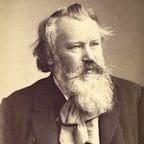 Antonín Dvořák (1841-1904)
Largo from the Symphony No. 9 in E minor, Op. 95 (From the New World)
In 1892, Jeannette Thurber made Dvořák an offer he couldn’t refuse. Thurber, the wife of a wealthy New York businessman, had founded the National Conservatory of Music in 1885, and recruited some of the finest teachers in the world to serve on its faculty. Thurber resolved to hire Dvořák as the director of the Conservatory. He was lukewarm at first, but the terms she offered were very generous: a two-year contract, with very light teaching duties and four months’ paid leave each year. The annual salary, $15,000, was about 25 times what Dvořák was making as an instructor at the Prague Conservatory, and in the end he accepted, eventually spending about three years in America. The “New World” Symphony is the most famous of the works Dvořák composed while in America. According to Thurber, the symphony was written at her suggestion. She felt that Dvořák should write a symphony “…embodying his experiences and feelings in America.” It was an immediate hit with audiences in both America and Europe. The new symphony closely matched the style of his other late symphonies, a style based upon the German symphonic works of his mentor, Brahms, and with occasional hints of Bohemian folk music. There are a few “Americanisms” in the Symphony No.9, however. According to his own account of the work’s composition, Dvořák attempted to capture the spirit of American music in the Symphony No.9, and he was particularly interested in two forms of music that had their origins in the United States: Native American music and Black spirituals. Dvořák frequently quizzed one his students at the National Conservatory, the talented young African American singer Harry T. Burleigh, about spirituals, and he dutifully transcribed every spiritual tune Burleigh knew. His contact with Native American music was a little more tenuous—the only time he ever heard an “authentic” Indian performance was when he went to Buffalo Bill’s Wild West Show! While he did not quote any true American melodies in the symphony, Dvořák immersed himself in American music and culture, and wrote musical themes from this inspiration.
According to Dvořák, the second and third movements were inspired by Longfellow’s Song of Hiawatha. The Largo evokes Hiawatha’s “Funeral in the Forest.” This movement opens with a solemn chorale, which leads into the main theme, a long romantic melody. (This melody became popular as a nostalgic song called Goin’ Home—so popular, in fact, that it was widely assumed that it was a traditional spiritual that Dvořák had quoted!) This arrangement includes a brief contrasting middle passage before a return of the main theme.
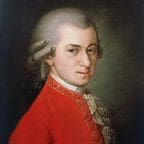 Wolfgang Amadeus Mozart (1756-1791)
Adagio from Concerto for Clarinet and Orchestra in A Major, K.622
Though Mozart actively sought commissions from theaters and princes, his personal friendships were often just as important in the creation of new works. This was the case with his only concerto for clarinet, written for his drinking-buddy and fellow Freemason, Anton Stadler. Stadler was one of the early virtuosos on what was then a relatively new instrument, the clarinet. He and Mozart met in 1783, and remained friends until Mozart’s death. Stadler seems to have been one of the many associates that took advantage of the composer in Vienna, borrowing money that was never repaid, acting as Mozart’s “business partner” (much to Stadler’s own advantage), and generally sponging off his unfailingly good-natured friend. Some biographers have even suggested that Stadler was responsible for the disappearance of Mozart’s autograph score for the clarinet concerto, and that he may even have purloined other works by Mozart to publish under his own name. For his part, Mozart was tolerant of Stadler’s mooching, and maintained a joking friendship: in a letter to his wife, he described Stadler as “a bit of an ass.” Mozart adored the clarinet and Stadler’s playing, however, and composed several works with Anton Stadler and his brother Johann, also a clarinetist, in mind: Masonic Funeral Music (1785), the Clarinet Trio, K.498 (1986), the Clarinet Quintet, K.581 (1789), and an alternative version of the Symphony No.40 (1788). At this early stage in its evolution, the clarinet was still the subject of constant experimentation and Stadler was an enthusiastic innovator. There were, at the time, two primary forms of the instrument, a soprano and a now-obsolete alto form called the basset horn; this latter was part of the scoring of the Requiem. In 1788, Stadler created an instrument he called the “basset clarinet,” which extended the soprano’s range downwards by four notes. This was the instrument for which Mozart wrote both the Clarinet Quintet and the Clarinet Concerto, though there is an earlier sketch of the concerto that appears to have been written for basset horn.
The second movement (Adagio) exploits all of the cantabile capabilities of the clarinet. The main theme is among the most beautiful melodies ever written for the instrument: a simple and gently rising idea that is lightly developed. The expressive connections to the closely contemporary Die Zauberflöte are clear in the operatic style of the central section. [Note: There is a tragic postscript to the story of the Clarinet Concerto. Though Stadler probably played the first performance in Prague in October 1791, he returned to Vienna to play the concerto on November 18. This was to be Mozart’s last public appearance: after conducting the concert, he fell ill and took to his bed, dying just a few weeks later.]
Rondo: Allegro from Concerto No.3 in E-flat Major for Horn and Orchestra, K. 447
Another of Mozart’s closest friends was a hornist named Josph Leutgeb. Leutgeb was already known as a virtuoso in Vienna in the 1750s. He spent much of the 1760s and 1770s in Salzburg, where he was closely associated with the Mozart family, and though Leutgeb was over 20 years older than young Wolfgang, they forged a lifelong friendship. Leutgeb toured extensively as a soloist, but when he returned to Vienna in 1777, he abandoned his professional career to run a small cheese and sausage shop (purchased in part with loan from Mozart’s father Leopold). When Mozart moved to Vienna in 1781, he quickly renewed their friendship. Mozart eventually wrote four concertos for Leutgeb (There is also a fifth, fragmentary concerto, and the horn part of his Quintet for Horn and Strings, K.407). Like many of Mozart’s friends he was the butt of a great deal of good-natured practical joking and insults. This extended to the music itself. The solo line in the Concerto No. 1 included an outrageously insulting running commentary. In the Concerto No. 2, Mozart wrote the following dedication: “Wolfgang Amadé Mozart finally took pity on Leutgeb, [the] Ass, Ox, and Fool,” and in the Concerto No. 4, poor Leutgeb had to decipher a 4-color code to play the solo part. (Leutgeb apparently escaped abuse only in the Concerto No, 3!) There seems to have been genuine affection on both sides, however. Mozart would often stay as a houseguest with the Leutgebs when Constanze Mozart was away. Leutgeb is actually mentioned in Mozart’s last letter, which describes to Constanze how they attended a performance of his opera La Clemenza di Tito together. When Mozart died, it was Leutgeb who helped Constanze to organize the great mass of manuscripts he left behind.
The Concerto No.3 (1787) is perhaps the most popular of the horn concertos. His use of clarines in the original scoring may have been inspired by another of his Viennese musical cronies, Anton Stadler. In the final movement (Rondo:Allegro) the horn writing recalls its origins as a hunting instrument. The rollicking main theme is introduced by the horn in the first few bars. There are several changes of character as the movement progresses, but the solo line always finds a witty way to get back to this main idea.
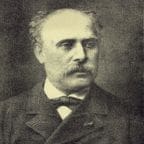 Émile Waldteufel (1837-1915)
Skaters Waltz (Les Patineurs)
Émile Waldteufel was one of the leading figures in Parisian popular music, and like his great Viennese contemporary Johann Strauss II, Waldteufel lived in the heyday of the waltz. Waldteufel became court pianist to Napoleon III and eventually took over his father’s dance orchestra, which became the mainstay of Parisian high society balls. He composed over 300 works, mostly waltzes and other popular dances for the family orchestra, but is known today largely for a single work, his Skaters Waltz (Les Patineurs). Written in 1882, the waltz was inspired by skaters at the Bois de Boulogne, a popular park on the outskirts of Paris. The “Boulogne Woods” became one of the most popular outdoor destinations for Parisians after it was made into a park and extensively landscaped in the mid 19th century. It hosted picnics, rowing, cycling, and hiking in summers and skating on its upper lake in the winter. The Skaters Waltz begins with a lilting tune that is the perfect picture of graceful French skaters. Waldteufel alternates between elegant music and more daring swoops as the skaters pirouette and leap.
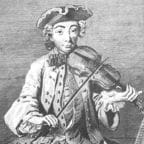 Michel Corrette (1709-1795)
Allegro from Sonata in D minor, Op.20, No.2
Michele Corrette was a respected organist—the son and father of respected organists—composer, and teacher. He was perhaps best known in his day as a teacher and as the author of a series of method books for violin, cello, flute, viola da gamba, organ, harpsichord, guitar, mandolin, double bass, and harp. Corrette’s books are notable for their flashes of humor and for their careful comparisons of Italian and French styles of playing. Not surprisingly, they are a rich source of information on performance practice for today’s players of Baroque music. Corrette’s Les délices de la solitude (The Delights of Solitude), Op.20 was published in 1738 or 1739. It is a collection of six short sonatas for cello, bassoon, continuo. In this performance the opening Allegro of the second sonata, bassoon plays the highly decorative solo part, while cello and organ perform the continuo. Each half ends with a distinctive unison refrain.
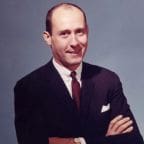 Henry Mancini (1924-1994)
Theme from The Pink Panther
Though Henry Mancini studied briefly at Juilliard, this thoroughly successful composer was largely self-trained. Also a talented arranger, he started his career writing for big bands. He became one of the sought-after arrangers in America, and created arrangements for popular singer (most notably for Frank Sinatra) but also for his own series of successful recordings. Mancini had a parallel career as a film and television composer, becoming a staff composer at Universal Studios in 1952. He worked at a phenomenal rate, completing more than a dozen film scores a year through most of the 1950s and 1960s, often in his distinctive Jazz-influenced style. Mancini had a particularly close working relationship with director Blake Edwards, and in 1963 he scored Edwards’s outrageous comedy The Pink Panther, which introduced the character of bumbling Inspector Closeau, memorably played by Peter Sellars. Mancini wrote the film’s slinky main theme to accompany the animated opening credits created by Friz Freling. In the credits the theme is played seductively by tenor saxophonist Plas Johnson, a studio session musician with whom Mancini had worked, and Mancini created the theme with Johnson’s cool sound specifically in mind.
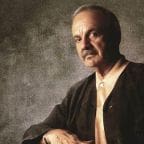 Astor Piazzolla (1921-1992)
Winter from Four Seasons of Buenos Aires
The Argentine composer Astor Piazzolla was a child prodigy on Argentina’s national instrument, the bandonéon—the large button accordion that is the lead instrument of the Tango. His parent\ moved to New York City when he was very young, and while still a teenager in the U.S., he met and was befriended by the great Argentine singer and matinee idol Carlos Gardel. He returned to Argentina at age 16 and spent the next several years playing in dance bands, eventually leading his own successful orquesta típica, the standard ensemble of Tango. He studied classical music with composer Alberto Ginastera, but in 1954 won a scholarship to study in Paris with one of the 20th-century’s great composition teachers, Nadia Boulanger. It was Boulanger whom Piazzolla credited with helping to create his own style. In an interview years later, he recalled how she spent two weeks working her way through the modernist scores he brought with him, before she finally concluded that they showed a complete lack of spirit, and goaded him into playing the kind of music he played at home. He reluctantly played one of his own Tangos, and, according to Piazzolla, “When I finished, Nadia took my hands in hers, and with that English of hers, so sweet, she said, ‘Astor, this is beautiful. I like it a lot. Here is the true Piazzolla—do not ever leave him.’ It was the great revelation of my musical life.” Piazzolla returned to Argentina after a year in Paris, and began to forge a distinctive style, eventually known as “Nuevo Tango” (New Tango). proved to be controversial in his homeland: while Tango is among the world’s sexiest dances, the music is quite tradition-bound, played by a standard ensemble, the orquesta típica, of bandonéon, violins, piano, piano, and double bass. Piazzolla’s works eventually included electric bass and guitar, synthesizer, and other distinctly “non-típica” instruments. He also channeled a wide range of musical ideas, from Jazz and Fusion to more avant garde idioms—but with the syncopated sensuousness of the tango always present.
By the end of his career Piazzolla was widely heard and commissioned around the world. And the creation of “new” Piazzolla works continued after he died The Four Seasons of Buenos Aires (Cuatro estaciones porteñas) heard here is a posthumous collaboration. Piazzolla wrote the four sections of this work for his quintet (bandoneón, piano, violin, electric guitar, and electric bass) in the late 1960s. In 1999, the Russian composer and arranger Leonid Desyatnikov, working with violinist Gidon Kremer, reworked Piazzolla’s originals into a set of four virtuoso movements for solo violin and string orchestra. This arrangement, adapted here for organ, transforms Piazzolla’s originals into a set of virtuoso character pieces, very much in the spirit of Vivaldi’s famous Four Seasons.
Piazzolla’s Winter (Invierno porteñas) opens with pure Tango—melancholy, with just a hint of menace. This mood is broken by a brief solo cadenza, before the solo line and the organ eturns to the opening music, winding around one another like a pair of dancers. A brief episode includes a sly reference to Vivaldi—the Summer concerto. The sensuous opening melody is eventually transformed into a more aggressive Tango (with some background lifted from Vivaldi—blink and you’ll miss it…), before a return of the opening mood. The ending is a wry little pseudo-Baroque coda over a repeating ground bass.
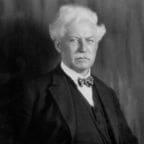 Wilhelm Middelschulte (1863-1943)
Perpetuum Mobile for Pedals Alone
Born in Germany. Wilhelm Middelschulte spent nearly 50 years in Chicago, Where he played organ for the Theodore Thomas Orchestra (predecessor of today’s Chicago Symphony Orchestra), and toured widely as a soloist. Middelschulte was renowned as an interpreter of the works of J. S. Bach, and this was reflected in many of his original works. His best-known composition, the Concerto over a Theme of Johann Sebastian Bach was published in 1906. All five movements are based upon the fugue subject of Bach’s monumental Prelude and Fugue in E minor, BWV 548. [Note: Organist Ken Cowan played this Bach work on this concert series in November 2023.] The massive Fugue, some 231 measures long, is Bach’s longest fugue, and certainly one of his most spectacular essays in this form. Its subject gave this fugue its nickname, the “Wedge Fugue.” Heard unaccompanied at the beginning of the fugue, the subject begins on the note E, and the theme that follows expands chromatically above and below that pitch, creating a kind of musical “wedge.” The Perpetuum mobile (Perpetual Motion) is the fourth movement (Intermezzo) of the work. A stunning virtuoso showpiece on the pedal board, this calls for techniques like harmonizing a melody with the heel and toes of the right foot! This was apparently a favorite encore piece for Middelschulte’s former student Virgil Fox, one of the great organists and showmen of the 20th century.
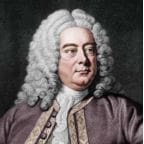 George Frideric Handel (1685-1759)
Organ Concerto in G minor, Opus 4, No. 1, HWV 289
Arguably the most successful of all Baroque composers, George Frideric Handel was already an international star when he moved to England permanently in 1717. For many years he flourished as a composer and promoter of Italian opera. By the 1730s, however, English audiences had tired of Italian opera, with its elaborate dramatic conventions and ridiculously convoluted plots, all set in a language that most of the audience did not understand. Faced with financial ruin, Handel discovered—or rather created—a new form, the English oratorio. It was a financial masterstroke. To produce opera involved costly sets, costumes, and stage machinery, and even more costly prima donnas and castrati. However, Handel produced his oratorios with local soloists and choristers, at a fraction of what his operas had cost. The new works, which told familiar Biblical stories (in a language that the audience could understand!), were phenomenally successful. Long after Handel’s death, and long after his operas and instrumental works had faded from memory, his oratorios were being performed again and again, and they have never fallen out of the repertoire.
One of the English traditions Handel adapted was connected to St. Cecelia, the patron saint of music and musicians. Even in rigororously Protestant England, she was celebrated annually, though British celebrations tended to take on a much more secular tone. (They focused more on the power of music rather than her more specifically Catholic legend.) By the 1680s, large musical celebrations were held in London each year, the centerpiece of each being an ode written in her honor, which set to music by one of the best composers of the day. In 1697, poet John Dryden wrote the ode Alexander’s Feast, an imaginative description of the music at a feast for Alexander the Great…which manages to bring in St. Cecelia at the end. It had already been set to music by Jeremiah Clarke and two later composers when Handel composed his oratorio-style version of Alexander’s Feast. First presented in London’s Covent Garden in February 1736, the ode was a sensational hit: it was one of only two vocal works by Handel that was printed in full score during his lifetime. (This score was actually included in a statue of Handel commissioned in 1738.)
Handel inserted three instrumental concertos into the lavish 1736 production of Alexander’s Feast, including the Organ Concerto in G minor heard here. It was published in 1738 as the first of six organ concertos, Op. 4. Set in for movements, it opens with a rather serious and pompous movement marked Larghetto e staccato. This links into a cheerful, bustling Allegro, filled with “cuckoo” motives. The brief, solemn Adagio, largely for organ alone, served a bridge into the final movement, an extended Andante. This closing movement alternates between a texture where the organ is playing decorative figuration above the orchestra, and striking call and response between the soloist and accompaniment.
program notes ©2026 by J. Michael Allsen
To view current and past program notes, please visit Michael Allsen’s website.